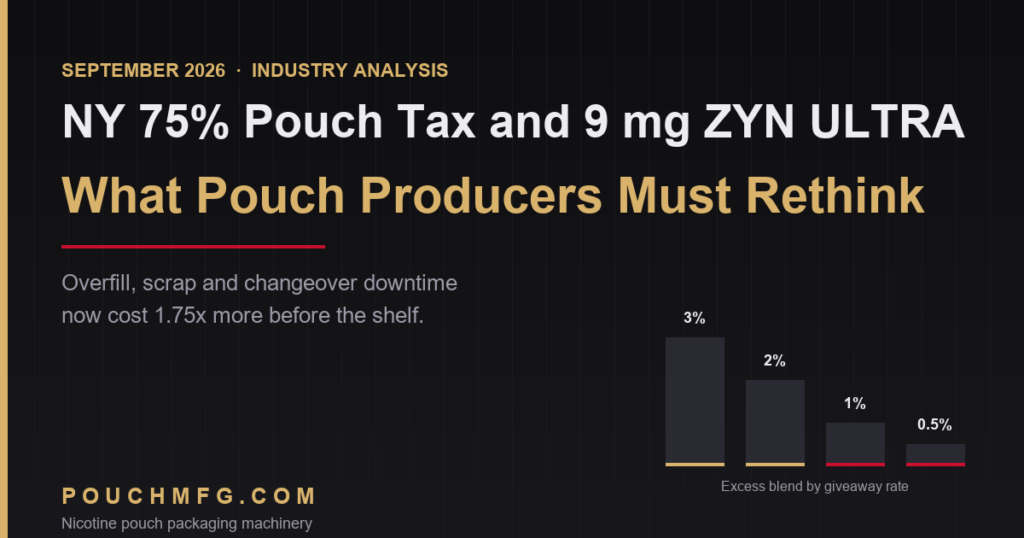
New York State began taxing nicotine pouches at 75% of wholesale price on 1 September 2026, and the FDA cleared the first pouches above 6 mg the same month. Together they change how a nicotine pouch packaging machine line should be specified: every gram of overfill, every percent of scrap and every hour of changeover downtime is now multiplied by roughly 1.75 before it reaches the shelf. This is how to scale a nicotine pouch production line for US demand in 2026 without donating margin to a tax authority.
What exactly changed in New York on 1 September 2026?
New York extended its tobacco products tax to “alternative nicotine products” — non-combustible products containing nicotine but no tobacco, covering pouches, gums and lozenges. Vapor products are excluded; FDA-regulated cessation drugs are exempt.
| Item | Detail | Date or deadline |
|---|---|---|
| Tax rate | 75% of wholesale price, paid by the distributor | Effective 1 Sept 2026 |
| Floor tax | One-off 75% tax on all stock held at 23:59 EST | Inventory count 31 Aug 2026 |
| Floor tax return | Form MT-200.5, filed with payment | Due 21 Sept 2026 |
| Licensing | Distributors, wholesalers and retailers need a tobacco products licence | Required by 1 Sept 2026 |
| Projected revenue | USD 18 million year one, USD 44 million at full implementation | Governor budget office |
Philip Morris International warned publicly that the change would fuel illicit trade in channels with no age verification. Whatever happens there, the direction is clear: the legal channel now carries a heavy ad valorem load, and cost discipline inside the factory stops being optional.
Why does a wholesale tax change machine specifications?
Because the tax is ad valorem, not per unit. At 75% levied on wholesale, one dollar of avoidable production cost does not cost the shopper one dollar — it costs about USD 1.75 once the tax applies on top.
- Cost cuts scale up. Removing USD 1 of cost per can can remove up to USD 1.75 from the pre-retail price.
- Waste scales up. Overfill, rejected seals and idle changeover hours sit inside wholesale cost, so they are taxed too.
- Accuracy beats speed. 360 pouches per minute at 1% giveaway can beat 500 pouches per minute at 3%.
How much does 3% overfill really cost?
Take a mid-range line: 6 lanes at 60 cycles per minute, two 8-hour shifts, 250 working days a year. That is 360 pouches per minute and 86,400,000 pouches a year, at a 0.50 g target fill and a blend cost assumed at USD 30 per kg.
| Mean fill (target 0.50 g) | Giveaway | Excess blend per year | Direct cost | Incl. 1.75x multiplier |
|---|---|---|---|---|
| 0.5150 g | 3.0% | 1,296 kg | USD 38,880 | USD 68,040 |
| 0.5100 g | 2.0% | 864 kg | USD 25,920 | USD 45,360 |
| 0.5050 g | 1.0% | 432 kg | USD 12,960 | USD 22,680 |
| 0.5025 g | 0.5% | 216 kg | USD 6,480 | USD 11,340 |
Moving a filler from 3% to 1% average giveaway frees about USD 26,000 of direct blend cost, roughly USD 45,000 once the multiplier applies. In practice that is the gap between an auger filler with periodic manual check-weighing and a servo dosing head under closed-loop weight feedback.
Why do higher-strength SKUs raise the dosing accuracy bar?
On 21 August 2026 the FDA issued marketing orders for eleven ZYN ULTRA pouches — ten at 9 mg, one 11 mg Smooth — the first ever authorised above 6 mg, taking the authorised pouch total to 43. Philip Morris has also flagged 1.5 mg and 8 mg dry variants for the third quarter. The consequence is easy to miss: the same percentage overfill wastes far more nicotine API as strength rises.
- At 3 mg and 0.50 g fill, 3% overfill wastes about 0.09 mg of nicotine per pouch, roughly 7.8 kg of API per year on the line above.
- At 9 mg, the same 3% overfill wastes about 0.27 mg per pouch, roughly 23.3 kg of API per year, three times as much.
- At an 11 mg target, a ±2% dosing deviation is ±0.22 mg per pouch; at 1.5 mg it is ±0.03 mg. Both are label-compliance questions, not only cost questions.
If your line was commissioned for a 3–6 mg world, its dosing system was likely specified to a tolerance now too loose for the SKUs customers are asking for.
How does SKU growth change what matters in a line?
The category is fragmenting. Pouches reached 59.9% of the US oral tobacco category in Q2 2026, up 8.1 share points year on year, while Turning Point Brands reported Modern Oral net sales up 128% to USD 68.4 million. Each strength and flavour is another changeover: at 12 SKUs and two changeovers a day across 250 days, that is 500 changeovers a year.
- At 45 minutes each: 375 hours of downtime per year.
- At 15 minutes each: 125 hours per year.
- The 250-hour gap is 5.4 million pouches of lost capacity at 360 pouches per minute.
That is why recipe-driven servo changeovers, tool-free format parts and pre-stored recipes now matter more than the headline speed on a datasheet. A machine rated at 1,200 pouches per minute that needs an hour to swap pouch width loses to a 600 ppm machine that swaps in twelve minutes.
What to check before you buy or upgrade a nicotine pouch line
- Buy flexibility before peak speed. Size for realistic annual volume, then spend the difference on fast changeover. A line that cannot take a rush order costs customers.
- Make dosing accuracy contractual. Ask for demonstrated capability at your real fill weight and material — say ±1% on a 0.50 g dry blend — verified at factory acceptance testing with your own powder, not a proxy.
- Time a real changeover between two pouch widths, with your own operators after training, not the supplier engineer.
- Get the scrap rate at rated speed with the reject logic explained. A machine that hides rejects by slowing down is not a 1,200 ppm machine.
- Check material compatibility: non-woven tolerances, seal temperature window, and whether seal jaws hold tolerance across an eight-hour run.
- Insist on batch-level records. Floor-tax inventory counts and excise audits reward machines that export per-batch counts, reject counts and weight logs. Retrofitting traceability costs far more than specifying it.
For a second opinion on those six numbers, contact our engineering team with your pouch format, target fill weight and annual volume. Brands that would rather not own equipment can run the same lines through our OEM pouch manufacturing programme, and the wider sachet and stick pack machinery range covers adjacent formats. You can also read more about PouchMfg.
Where these numbers come from
- New York State Department of Taxation and Finance, Form MT-200.5 instructions and Notice N-26-2, August 2026.
- FDA Center for Tobacco Products, marketing granted orders for eleven ZYN ULTRA pouches, 21 August 2026.
- Altria and Turning Point Brands Q2 2026 results.
The cost model uses stated assumptions — 6 lanes, 60 cycles per minute, 16 hours a day, 250 days, 0.50 g target, USD 30 per kg blend — so you can substitute your own figures. The conclusion does not depend on them: under an ad valorem wholesale tax, precision is worth more than speed.