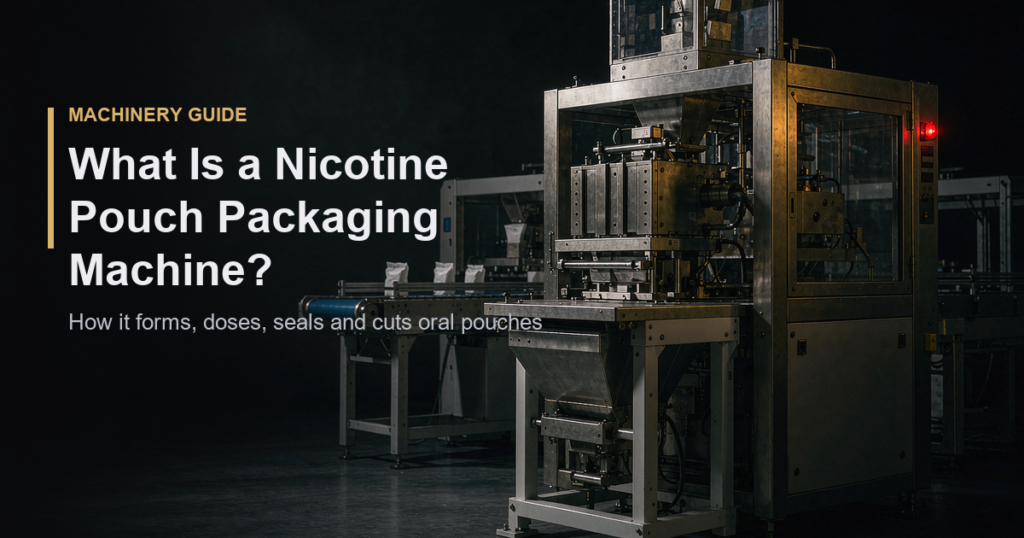
A nicotine pouch packaging machine is a form-fill-seal system that meters a precise dose of nicotine or tobacco-free blend, wraps it in a breathable non-woven material, seals the pouch, and discharges it ready for can filling. Typical machines dose 0.4-1.2 g per pouch with servo auger or vacuum dosing, run non-woven cellulose or PLA pouch material, and seal by ultrasonic or impulse welding at speeds from 40 pouches per minute on an entry-level single-lane unit to more than 1,200 pouches per minute on a multi-lane line.
If you are evaluating equipment for an oral pouch brand, a contract packing operation, or a factory extension, the definitions below cover what the machine is, what it does step by step, and which numbers actually decide whether a line makes money.
What is a nicotine pouch packaging machine?
A nicotine pouch packaging machine converts a loose, conditioned blend into sealed, portioned pouches. The blend may contain tobacco, nicotine salts, caffeine, or botanicals; the pouch material is almost always a food-contact non-woven or biodegradable web rather than a plastic film, because the material has to release flavour through the gum while keeping the powder inside.
The machine performs four jobs in one continuous cycle: it forms the pouch from a flat roll of web, doses a target weight of blend into it, seals the open edges, and cuts the finished pouch free. Downstream modules then count, check-weigh, and feed pouches into cans.
Most buyers meet this equipment under several names – nicotine pouch packaging machine, oral pouch machine, snus packing machine – all of which describe the same core process.
How does a nicotine pouch packaging machine work?
The cycle runs in eight steps, repeated once per pouch per lane:
- Web unwind and tension control. A roll of non-woven material is pulled off the unwind shaft. A dancer arm or servo-controlled brake keeps tension constant, because slack web produces crooked seals.
- Web tracking and forming. The flat web passes over a forming shoulder that folds it into a tube or pillow shape. Photo-eye registration holds the print or colour mark in position.
- Longitudinal seal. The overlapping edge is welded. On pouch machines this is usually a 4-5 mm back seal, either plain or textured.
- Conditioning and feeding of the blend. The blend sits in a hopper with agitation and anti-clumping. Moisture content matters: most machines handle 8%-40% moisture, but a very wet blend bridges in the hopper and a very dry one flows too fast.
- Dosing. A servo auger, vacuum drum, or miniature dual-metering system measures the target weight – commonly 0.5 g – and drops it into the formed pouch.
- Cross seal and cut. Sealing jaws close across the web, welding the top of the filled pouch and the bottom of the next one in a single stroke. A knife or rotary cutter separates them, often with a rounded-corner profile.
- Inspection. A check-weigher or vision system verifies fill weight and seal integrity; out-of-tolerance pouches are rejected automatically.
- Counting and discharge. Good pouches are counted into batches and transferred to a can filler, bulk bagger, or secondary packaging line.
What are the main components?
| Module | Function | What to check when buying |
|---|---|---|
| Hopper and feeder | Holds and loosens the blend; agitation prevents bridging | Hopper geometry for your moisture level; tool-free removal for cleaning |
| Dosing unit | Meters a target weight per pouch | Servo auger with load-cell feedback, not a fixed volumetric cup |
| Forming set | Shapes the web into a pouch | Changeover time between pouch sizes; colour-coded tooling |
| Sealing system | Welds longitudinal and cross seams | Ultrasonic vs impulse; independent temperature and pressure control |
| Cutting unit | Separates finished pouches | Rounded-corner or straight cut; scrap handling |
| Control panel | Stores recipes, manages alarms | Recipe storage, multi-language HMI, data export for batch records |
| Inspection | Check-weighing, metal detection, vision | Auto-reject and reject logging |
How accurate is the dosing, and why does it matter?
Entry-level lab machines for product development quote around ±10% dosing accuracy at 40 pouches per minute – acceptable when you are writing a recipe, not acceptable in production. A production line with servo auger dosing and in-line weight feedback holds ±1-2% at target weight.
The difference is pure material cost. A 4-lane line running 0.5 g pouches at 300 pouches per minute per lane produces roughly 48 million pouches per year. Moving average overfill from +3% down to +1% recovers about 48 kg of blend per year – which, at a typical $60 per kilogram blend price, is around $2,900 saved, before you count the regulatory exposure of underfilled pouches.
Accuracy is also a compliance issue. Markets that tax nicotine by weight or cap per-pouch strength require documented fill-weight distribution, not just an average.
What pouch materials does it run?
| Material | Characteristics | Typical use |
|---|---|---|
| Non-woven cellulose | Breathable, soft on the gum, widely approved | Standard nicotine and tobacco-free pouches |
| PLA biodegradable | Compostable, slightly stiffer handle | Sustainability-positioned brands |
| Mesh fibre blend | Stronger wet strength, premium mouthfeel | Moist snus and high-moisture products |
Sealing method follows material choice. Ultrasonic sealing bonds the web with high-frequency vibration and no applied heat, which suits heat-sensitive blends and gives a clean, cold seam. Impulse sealing applies short, localised heating and costs less. Either way, seal quality depends on pressure, dwell time, and material thickness – a shift of a few tenths of a second in dwell time is enough to cause leaks.
What pouch formats and fill weights are typical?
| Format | Target fill weight | Approx. pouch size |
|---|---|---|
| Slim | 0.4-0.5 g | ~30 × 50 mm inner bag |
| Standard | 0.5 g | ~30 × 75 mm outer bag |
| Large | 0.8-1.2 g | Wider forming set, higher dose |
Confirm the size range before you sign. Entry-level units typically cover 30-50 mm bag length at 13 mm width; production frames are built to the pouch size you specify, and retrofitting a wider format later is far more expensive than specifying it up front.
How fast is a nicotine pouch packaging machine?
Speed is stated in pouches per minute for the whole machine, not per lane – a figure that trips up a lot of first-time buyers.
- 40 ppm – single-lane entry or lab machine for formulation work and market testing.
- 250-300 ppm – single-lane production machine, typical for a brand producing a few million pouches a year.
- 600 ppm – dual-lane configuration.
- 1,000-1,200 ppm – 4-lane or wider multi-lane line for contract packers and high-volume brands.
Real output is lower than the nameplate figure. Moisture content, blend flow behaviour, and downstream can-filling speed are the three constraints that decide what you actually ship.
How is it different from a sachet or stick pack machine?
All three are form-fill-seal machines, but they differ in web material, seal geometry, and dose size. Sachet and stick pack machinery runs laminated plastic or foil film and seals it hermetically; a nicotine pouch machine runs a breathable non-woven and seals it without blocking airflow. Stick packs are typically tall, narrow, and cut for liquid or powder that the consumer pours out. Oral pouches are short, soft, and designed to sit in the mouth.
The practical consequence: you cannot simply switch a sachet machine to pouch material. The dosing range, the seal energy, and the web tension requirements are all different.
What should you prepare before requesting a quote?
- Blend sample. At least 1-2 kg of the actual production blend, with measured moisture content and bulk density. Machine configuration is only as good as the material tested on it.
- Target fill weight and tolerance. 0.5 g at ±1% is a different machine from 0.5 g at ±5%.
- Pouch dimensions and material. Web width, bag length, and whether you want non-woven, PLA, or mesh.
- Required output per shift. Nameplate ppm or annual pouch volume – ideally both.
- Downstream format. Cans, bulk bags, or OEM pouch manufacturing for private label.
- Utilities. Most machines need AC 220 V or 415 V three-phase plus 6 bar compressed air at roughly 0.4-0.6 m³/min.
Ask for a factory acceptance test on your own material before shipment, with agreed acceptance criteria on fill-weight variation, seal integrity, reject rate, and sustained running speed. Sampling should cover start-up, steady state, and restart after a stop.
What does a nicotine pouch packaging machine cost?
Prices span roughly $20,000 for an entry-level single-lane lab unit to several hundred thousand dollars for a multi-lane line with can filling, check-weighing, and secondary packaging. The dominant variables are lane count, dosing accuracy, material handling for your moisture level, and how much downstream automation is included. Total cost of ownership is where the decision is really made – the machine is a fraction of the blend you will run through it over ten years, which is why dosing accuracy and uptime usually beat headline speed.
Next steps
Start by defining your blend, pouch format, and target annual volume; those three answers determine the machine class. Then request a material trial rather than a brochure – a 20-minute run on your own blend tells you more than any specification sheet.
To discuss a configuration or arrange a trial, contact our engineering team. You can also read more about PouchMfg and how we build pouch lines for oral nicotine, snus, and caffeine pouch producers.