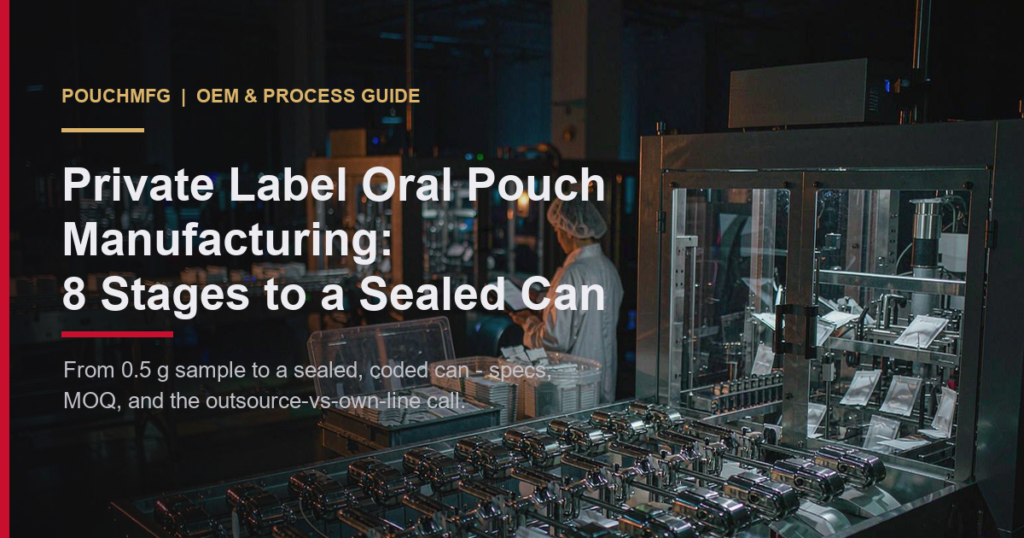
Private label oral pouch manufacturing is the process of having an outside producer make nicotine or functional pouches to your specification and put your brand on the can – you own the formula, the artwork, and the customer; the partner owns the blend room, the pouch line, and the batch records. A typical first run moves through 8 stages and takes 4-8 weeks from approved artwork to shipped pallets, at minimum orders that commonly start around 500-5,000 cans per SKU. Below: each stage, the specs to lock before sampling, and the break-even point where outsourcing stops making sense.
Private label vs white label vs contract packing: which one are you buying?
The three terms get used interchangeably, and that causes expensive misunderstandings. Before you sign anything, confirm which model your partner is actually offering:
| Model | Who owns the formula | Who owns the brand | Typical use case |
|---|---|---|---|
| White label | The producer | You (on a stock product) | Fastest entry; stock blend, your artwork |
| Private label | Shared – your spec on their base | You | Custom strength/flavor, medium MOQ |
| Full OEM / contract | You | You | Proprietary formula, highest MOQ, longest timeline |
If speed matters more than differentiation, white label is fine. If your whole pitch is a specific strength, moisture, or format – for example a 0.5 g slim caffeine pouch – you need at least private label, and the process below is what that looks like.
What are the 8 stages of a private label pouch run?
- Spec lock and brief. You define pouch format (mini ~0.35 g, slim ~0.5 g, regular ~0.7 g), nicotine or active strength, can count (typically 15-20 pouches), moisture style, flavor direction, and target market. Everything downstream is measured against this sheet.
- Ingredient sourcing. The producer procures nicotine (purity >=99%, tobacco-derived or synthetic), plant-fiber filler such as microcrystalline cellulose, pH adjusters, humectants, and flavorings – each with a Certificate of Analysis.
- Lab blend and bench sample. A small batch is mixed and hand-filled into sample pouches, usually within 3-7 working days. Expect benchtop dosing accuracy of roughly ±10% – good enough to judge flavor and feel, not for release.
- Conditioning. The blend rests so moisture and flavor equilibrate. Skip this and pouches from the same can will feel different – the single most common complaint about cheap pouch brands.
- Pilot run on a production machine. The blend runs on real filling equipment at pilot speed (300-400 pouches/min) in a batch of roughly 5,000-20,000 pouches. This is where the machine – not the lab – decides your final moisture, seal width, and weight consistency. Production-grade lines hold ±1-2% fill accuracy and a 4-5 mm seal.
- QC release testing. Batch is checked against the spec sheet before anything is canned.
- Canning, coding, and labeling. Pouches are counted into cans (20 × 0.7 g = 14 g net is a common configuration), foil-sealed, labeled, and laser or inkjet coded with a lot number.
- Documentation and shipment. You receive the batch pack – COA, batch records, ingredient declaration – then goods ship. Standard production after sample approval runs 10 days to 4 weeks.
What specs must be locked before sampling?
Sampling is cheap; re-sampling because the spec drifted is not. Lock these in writing first:
| Parameter | Typical range | Why it matters |
|---|---|---|
| Fill weight | 0.35-1.0 g per pouch | Drives dose, cost, and can net weight claims |
| Moisture | ~8-15% (dry style) to ~30-45% (moist portion) | Controls release speed and mouthfeel |
| pH | Product-specific, verified per batch | Determines nicotine absorption rate |
| Seal width | 4-5 mm | Integrity in transit vs easy open |
| Can count | 15-20 pouches | Units-per-can math for retail pricing |
How long does a private label launch actually take?
- Days 1-3: quote and spec agreement.
- Days 3-10: bench samples (3-7 working days is standard).
- Weeks 2-4: artwork, can design, compliance labeling; pilot run in parallel.
- Weeks 4-8: first production batch, QC release, shipment.
Custom formulation adds lab iterations – budget an extra 2-6 weeks for a from-scratch blend versus adapting a proven base.
What does QC release testing check?
A serious partner tests every batch – not just the first one – against five checks: active content (nicotine per pouch within spec), weight consistency (pouch-to-pouch, caught by automatic checkweighers on the line), moisture, pH, and seal integrity plus basic microbiology. Only batches passing all five should be released to canning.
What documentation should you receive with every batch?
Ask for this list before you place the first order, not after:
- Batch COA: nicotine content, pH, moisture, microbial results
- Batch/lot number and production date for every can
- Ingredient declaration and allergen statement
- Market-specific support: EU TPD notification data, or US documentation suitable for a PMTA file
Toll packing vs buying your own line: where is the break-even?
This is the decision every growing brand hits. Here is a transparent model – verify with your own quotes:
| Assumption | Value |
|---|---|
| Toll fee (fill, seal, can, label – excl. blend and materials) | USD 0.12-0.20 per can |
| Own line capital (2-lane ~600 ppm / 4-lane ~1,200 ppm machine) | USD 90,000-150,000 / 150,000-260,000 |
| Own line fixed cost per month (depreciation over 5 yr, 2-3 operators, consumables) | ~USD 7,000-8,500 |
| 4-lane output, 1 shift, 22 days (1,200 ppm × 8 h × 20 pouches/can) | ~630,000 cans/month |
At a mid-range toll fee of USD 0.15 per can, the break-even is roughly 50,000 cans per month. Below that, outsource – a 4-lane line would sit idle most of the day. At 150,000 cans/month, the spread (~USD 22,500 tolling vs ~USD 8,000 own-line running cost) is about USD 14,500 per month, which pays back a USD 180,000 line in ~12 months. Between those two numbers, the honest answer is: negotiate harder with your toll partner, or buy a compact 1-2 lane machine and keep utilization high.
The three mistakes that sink most first runs
- Skipping the pilot run. Going straight from a hand-made bench sample to a full production order means the first time your blend meets a machine is on your dime. Always buy the pilot batch.
- Freezing artwork before the fill weight is final. If the pilot moves you from 0.6 g to 0.5 g per pouch, your can net-weight claim, nutrition-style panel, and retail price math all change.
- Treating documentation as the supplier’s problem. You – not the toll manufacturer – are the one registering the product in your market. If a partner cannot produce a clean batch pack, walk away now.
What’s the next step?
If you are evaluating partners, use the 8 stages above as your audit checklist and ask to see the pilot run in person or on video. If your volumes are already past the break-even math, the conversation shifts from who packs for me to which nicotine pouch packaging machine fits my blend and format – our team covers sachet and stick pack machinery for oral pouch formats, and we support OEM pouch manufacturing from spec sheet to shipped can. To talk through your spec sheet with our engineering team, or to read more about PouchMfg and how we build pouch lines, reach out with your target pouch weight, can count, and monthly volume – those three numbers are enough for a first feasibility answer.