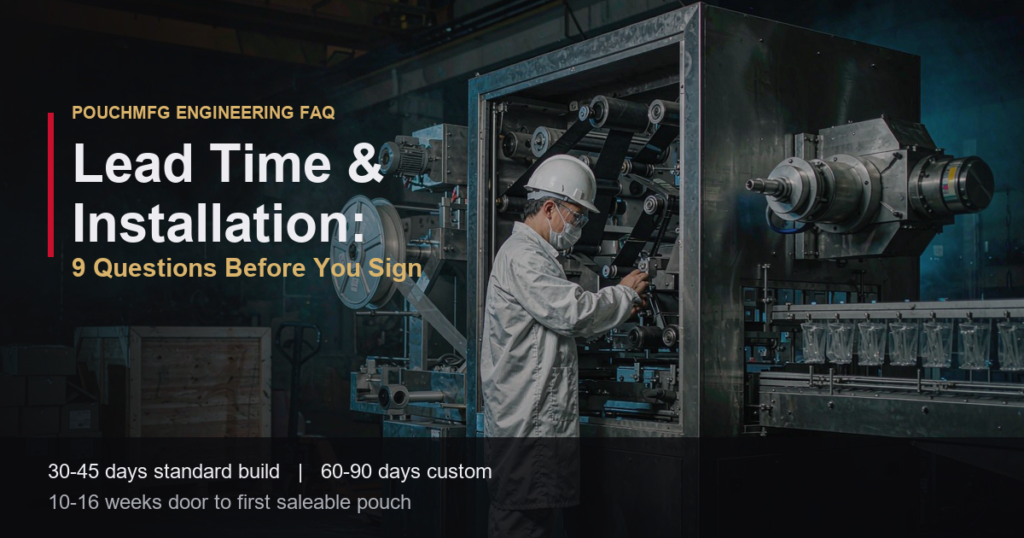
A nicotine pouch packaging machine takes 30-45 working days to build in a standard configuration and 60-90 days as a custom turnkey line. Add 3-6 weeks of sea freight, then 2-5 days of on-site installation and 1-7 days of commissioning before the line holds its quoted speed. The realistic door-to-first-saleable-pouch timeline is 10-16 weeks from signed order – not the 4-6 weeks most first-time buyers put in their launch plan.
The gap is almost never the machine build. It is drawings approval, film and blend arriving late for the factory acceptance test, and site utilities that turn out to be one size too small. Below are the nine questions buyers ask us most often before they sign, answered with the numbers we quote against.
1. How long is the lead time for a nicotine pouch packaging machine?
For a standard multi-lane nicotine pouch packaging machine in a stock lane configuration (2, 4, 6 or 8 lanes at an existing pouch format), budget 30-45 working days. A custom build – new pouch dimensions, a servo auger sized to a specific blend, integrated cartoning or checkweighing – runs 60-90 days. Turnkey lines that include upstream feeding, laser coding, vision inspection and robotic cartoning, with factory acceptance testing included, sit at the top of that range or slightly beyond.
Two clarifications matter in the contract. First, lead time starts at signed drawings plus deposit, not at your first email. Second, “working days” excludes public holidays at the builder – a Chinese New Year or Golden Week order can lose two to three calendar weeks that nobody counted.
2. What actually happens during those weeks?
Breaking the lead time into phases makes the quote negotiable, because you can see which phases you can compress and which you cannot.
| Phase | Standard build | Custom line | What slips it |
|---|---|---|---|
| Layout and drawings approval | 5-10 days | 2-4 weeks | Unanswered utility questions, late pouch artwork |
| Frame machining and dosing head build | 2-3 weeks | 3-5 weeks | Servo or PLC lead times from the component brand |
| Assembly, wiring, PLC programming | 1-2 weeks | 2-4 weeks | Scope changes after assembly starts |
| Internal dry run and tuning | 3-5 days | 1 week | No product sample on site to tune against |
| FAT with your film and blend | 2-3 days | 3-5 days | Film or blend shipped late to the factory |
Sending 200-500 g of the real blend and two rolls of the actual production film before assembly finishes is the single highest-leverage thing a buyer can do. Machines tuned on a substitute powder routinely need two extra days of auger and seal work after delivery.
3. How long does shipping and customs take?
Sea freight is the default and the cheapest; air is available at three to five times the cost when a launch date is at risk.
| Mode | Transit to Northern Europe | Transit to US East Coast | Cost indication |
|---|---|---|---|
| Sea freight, FCL or LCL | 3-5 weeks | 4-6 weeks | Baseline |
| Sea freight plus customs and inland | 4-6 weeks total | 5-8 weeks total | Baseline plus 1-2 weeks |
| Air freight | 5-10 days | 5-10 days | 3-5x sea |
Machines ship in ISPM-15 heat-treated wooden crates with vapour barrier and desiccant. Payment terms across the industry cluster around 30% deposit and 70% before dispatch, which means the balance falls due roughly four to six weeks before the machine lands – a cash-flow point that surprises finance teams. Confirm whether your quote is FOB, CIF or DDP before comparing numbers between suppliers, because the difference on a 2-tonne machine is material.
4. What site preparation does a multi-lane pouch machine need?
Site readiness is the most common cause of a one-day install becoming a week. These are the figures to verify against the layout drawing before the crate ships.
| Utility | Typical requirement, 4-8 lane line | The mistake we see most |
|---|---|---|
| Electrical | 380-415 V, 3-phase, 50/60 Hz, 7.5-11 kW | Single-phase or 220 V only at the drop; no dedicated breaker |
| Compressed air | 0.6-0.8 MPa, 300-500 L/min, dew point -40 °C | Compressor sized for tools, not continuous duty – pressure sags at speed |
| Floor | Level slab, verified load capacity, 12 mm neoprene isolation pads | Machine anchored hard to slab; seal defects from transmitted vibration |
| Clearance | Footprint plus 0.8 m rear, 1.2 m sides for service access | Room for the machine but not for opening the electrical cabinet |
| Environment | 18-24 °C; 8-15% RH for dry pouches, 30-45% for moist portions | Pouch line placed next to a washdown area or an open dock door |
| Network | Separate VLAN for PLC, HMI and vision system | Corporate IT firmware update crashes the HMI mid-shift |
A dedicated isolating transformer upstream of the drive cabinet is cheap insurance: voltage dips destabilise servo tuning loops long before they trip a breaker.
5. How many days does installation take on site?
Mechanical placement is fast. Process stabilisation is not.
- Unloading and positioning – half to one day, including levelling.
- Mechanical assembly – half to two days for hoppers, discharge chutes, conveyors, guards.
- Electrical and pneumatic hookup – half to two days by a licensed electrician.
- Dry run and safety checks – half to one day for interlocks, e-stops, jog tests.
- Product calibration – one to three days. This is where dosing accuracy is set: a servo auger should land inside ±1% of target, a volumetric cup at ±1-2%.
- Speed ramp and first article inspection – one to three days, checking seal integrity and fill weight at rated speed.
- Operator and maintenance training – half to two days.
A standalone machine with a prepared site reaches stable production in 2-5 days. An integrated line with cartoner, checkweigher and metal detector takes 7-21 days, because every subsystem handshake has to be commissioned separately.
6. What is FAT versus SAT, and should you attend?
Factory Acceptance Testing (FAT) runs the finished machine at the builder with your film and your blend, at or near quoted speed, typically for 2-8 hours depending on the contract. You verify pouch weight distribution, seal strength, reject rate and changeover time, then sign a protocol. Site Acceptance Testing (SAT) repeats the same checks on your floor after installation, with your utilities and your operators.
Attend the FAT in person if the line is custom, or if you have never commissioned equipment before. If travel is impractical, require a streamed FAT with live weight-check data and a signed video record – a written summary report alone is not enough, because it rarely shows the reject rate. Hold a portion of the final payment against SAT sign-off, not against dispatch; that single clause resolves most commissioning disputes.
7. What most often delays installation?
- Wrong voltage or unstable air. Verify before shipping, not on arrival day.
- Film or cans arriving after the machine. Order packaging materials when you place the machine order.
- Blend that differs from the sample. A moisture or particle-size change from your supplier invalidates the auger tuning done at FAT.
- No operator available for training. The handover date slips and the machine sits idle.
- Customs holding a crate for missing CE documentation, ISPM-15 marking or an HS code mismatch.
- Layout never re-checked against the approved drawing after a plant rearrangement.
8. What training and handover should you require?
Split training into two tracks. Operators need daily startup and shutdown, film threading, recipe selection, cleaning and the five alarms that cause 80% of stoppages. Maintenance needs belt tension, jaw and knife replacement, thermocouple checks, lubrication schedule and the sachet and stick pack machinery spare-parts list with part numbers.
Demand these deliverables at handover, not “later by email”: electrical and pneumatic schematics, PLC program backup, a bill of materials with commercial part numbers, calibration certificates traceable to a national standard, and the parameter sheet for the settings that produced your approved first article.
9. How can you shorten the timeline?
- Approve the layout drawing within five working days and freeze scope.
- Ship 200-500 g of real blend and two rolls of production film before assembly ends.
- Order film, cans and labels in week two of the build, not week eight.
- Complete site utilities and have them photographed to the supplier two weeks before dispatch.
- Name the operator and technician who will own the line, and put them in the FAT.
- Consider a phased delivery: machine first, cartoner on the second shipment, so you start making saleable pouches earlier.
Next step
If you are working backwards from a launch date, share three numbers with the engineering team: target pouches per month, pouch format and weight, and the date you need first saleable product. Those three determine lane count, dosing technology and whether a stock configuration will make your window – or whether you need OEM pouch manufacturing to bridge the gap while the line is being built.
Contact our engineering team for a dated project plan, or read more about PouchMfg and how we build and commission lines.