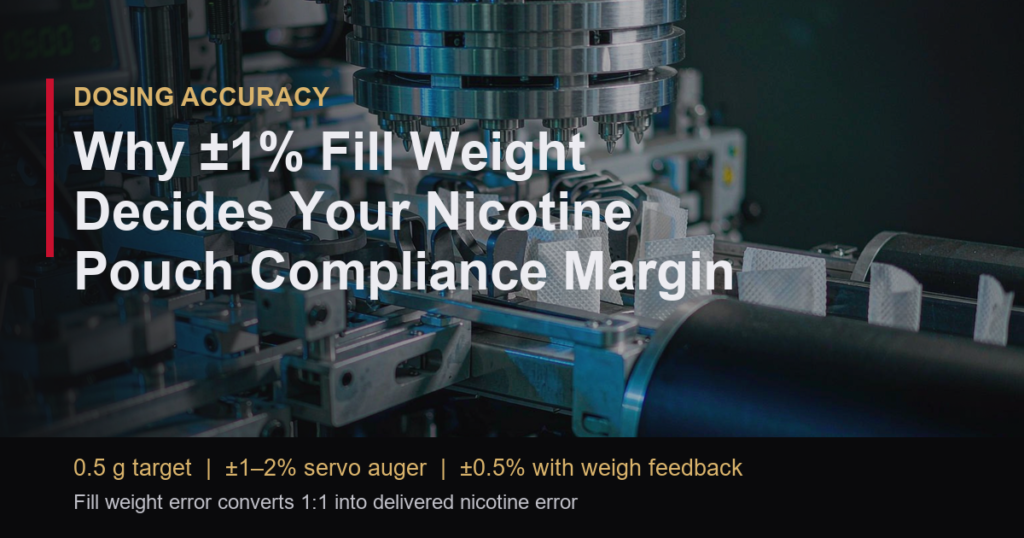
Dosing accuracy in nicotine pouch filling is the gap between the fill weight of each pouch and the target, expressed as a percentage. At a 0.5 g target, ±1% means every pouch lands between 0.495 g and 0.505 g. Production multi-lane machines hold ±1-2% with a servo-driven auger and ±0.5% or better once weigh feedback is added; benchtop laboratory dosers typically run ±5-10%. Three things ride on that number: how much blend you give away, whether the milligram claim on the can survives a market surveillance test, and whether the pouch a consumer opens on Friday feels like the one they opened on Monday.
What does dosing accuracy actually mean in pouch filling?
Accuracy is stated three different ways in supplier quotes, and mixing them up is the most common source of disappointment after installation.
- Repeatability (RSD): the standard deviation of a sample divided by its mean. This is the number that describes spread from pouch to pouch, and it is the one you should specify.
- Maximum deviation (±%): usually mean plus or minus three standard deviations. A supplier quoting ±1% is quoting roughly ±3 RSD of 0.33%.
- Resolution: the smallest increment the control system can resolve. A 0.001 g readability on a checkweigher does not mean the filler delivers 0.001 g repeatability on a cohesive blend.
Ask for RSD at a named target weight, on your blend, at a named speed. Everything else is marketing arithmetic. The same discipline applies whether you are buying a dedicated oral pouch line or adapting sachet and stick pack machinery for pouch formats.
How accurate does a nicotine pouch filler need to be?
For a commercial product sold into a regulated market, ±1% RSD on fill weight is the working target and ±2% is the practical floor. Below is how the common metering routes compare on a 0.3-1.0 g oral pouch dose.
| Metering route | Typical accuracy | Speed per lane | Best for | Watch out for |
|---|---|---|---|---|
| Volumetric cup | ±1-3% | 40-80 cycles/min | Free-flowing, stable bulk density | Blind to density drift; bridging |
| Servo auger, volumetric | ±1-2% (0.3-1% on good powder) | 60-150 cycles/min | Fine, cohesive, aerated blends | Screw geometry tied to dose size |
| Auger plus weigh feedback (fill-by-weight) | ±0.5% or better | 10-20% slower than pure volumetric | High-value blends, tight labels | Scale settling time, vibration |
| Multihead weigher | ±0.5-2 g absolute | 100-200 packs/min | Free-flowing granules, snacks | Too coarse for a 0.5 g cohesive dose |
| Benchtop laboratory doser | ±5-10% | 5-20 doses/min | Formulation work, samples | Never quote it as a production figure |
Notice the trap in the multihead row: ±0.5 g on a 0.5 g target is ±100%. Multihead weighers are excellent machines, they are just built for a different weight class. For 0.4-0.8 g oral pouch doses, an auger route wins.
Why does a fill weight error become a nicotine compliance error?
Because the number on the can is nicotine mass per pouch, and that mass is the product of two independent variables: milligrams of nicotine per gram of blend, and grams of blend in the pouch. A 1% error in either one is a 1% error in delivered nicotine. Regulators test the finished pouch, not your intention.
Several markets now cap that number directly.
| Market | Cap or rule | Practical implication |
|---|---|---|
| Denmark | 9 mg nicotine per pouch | Nominal claim needs headroom below 9 mg |
| Czech Republic | 12 mg per pouch (Decree 219/2023) | Strength ladder stops at 12 mg |
| France | XP V37-500, 16.6 mg per pouch | Plus mandatory toxicological risk assessment |
| Indonesia | Below 16.6 mg per pouch | Same ceiling, different documentation |
| EU CLP | Above 2.5 mg/g: GHS07 harmful; above 16.7 mg/g: GHS06 toxic | Blend strength, not pouch mass, triggers pictograms |
The EU Tobacco Products Directive does not set a numerical tolerance for labelled nicotine content, so the acceptable deviation is a matter of national enforcement practice. Independent testing published in Tobacco Control on 46 pouch varieties found measurable gaps between labelled and measured nicotine across brands, which is exactly the kind of evidence a surveillance authority uses. The safe engineering rule is simple: keep nominal strength at no more than 90% of the legal cap, and hold fill weight RSD at or below 1%, so the upper tail of the distribution still lands under the limit.
Where does the real variance come from?
Once a line is running, operators usually blame the doser. The doser is often only half the problem.
| Variance source | Typical share of total | What reduces it |
|---|---|---|
| Fill weight repeatability | 1.0-2.0% | Servo auger, weigh feedback, stable screw geometry |
| Bulk density drift in the hopper | 0.5-2.0% | Level control, gentle agitation, defined refill discipline |
| Blend homogeneity (mg per gram) | 1.0-4.0% | Validated blending time, ordered samples, cohesive mixing |
| Analytical method (GC-FID or HPLC) | 0.5-1.5% | Accredited lab, adequate sample size |
At a 1.5 mg strength the homogeneity term dominates. At 11 mg the fill weight term becomes equally important. This is why a machine upgrade alone rarely fixes a failing content-uniformity result.
How do you measure dosing accuracy during factory acceptance?
- Send 200-500 g of the real production blend and two rolls of production film. Trial powder and sample film hide problems.
- Run at three hopper levels: full, mid, and the last 20% before refill. Head pressure changes dose.
- Pull at least 30 consecutive pouches per lane, and keep lane identity. A good line average can hide one bad lane.
- Weigh on a balance with 0.001 g readability, and record mean, standard deviation, RSD, minimum and maximum.
- Repeat the sample after a restart and after a film splice, not only during steady state.
- Calculate Cpk against your specification window. Below 1.33, the process is not capable even if today average looks fine.
What should go into the machine specification?
- State accuracy as RSD, at a named target weight and speed, on your blend, not as a bare ±% number.
- Require per-lane data in the acceptance protocol, not a line average.
- Require checkweigher resolution of 1 mg or better for a 0.5 g target, with verified reject confirmation.
- Require tool-less auger and tube changes, because screw geometry is dose-specific: a 0.5 g screw will not hold tolerance at 0.7 g.
- Require recipe lock and an audit trail, so a shift adjustment cannot quietly move the target.
- Tie final payment to the FAT result, not to a datasheet claim.
What is better dosing accuracy worth?
Take a mid-sized line: 4 lanes at 100 cycles per minute, one 8-hour shift, 250 working days. That is 48 million pouches a year at 0.5 g, or 24,000 kg of blend. At USD 60 per kg the blend bill is about USD 1.44 million. Moving average overfill from +3% to +1% recovers 480 kg of blend, roughly USD 28,800 a year. On a machine in the USD 150,000-250,000 range, the tighter doser pays for itself through material alone, before counting the value of not having a batch rejected for content.
Where to go from here
Treat dosing accuracy as a specification you write, not a feature you hope for. Decide your target RSD, decide your nominal strength headroom against the strictest market you sell into, and make both measurable at factory acceptance with your own material. If you are sizing a new nicotine pouch packaging machine, or reviewing why an existing line drifts, contact our engineering team with your target weight, blend bulk density and lane count and we will run the numbers with you. You can also read more about our OEM pouch manufacturing route if you would rather validate a market before buying equipment, and read more about PouchMfg to see how we build and test lines.