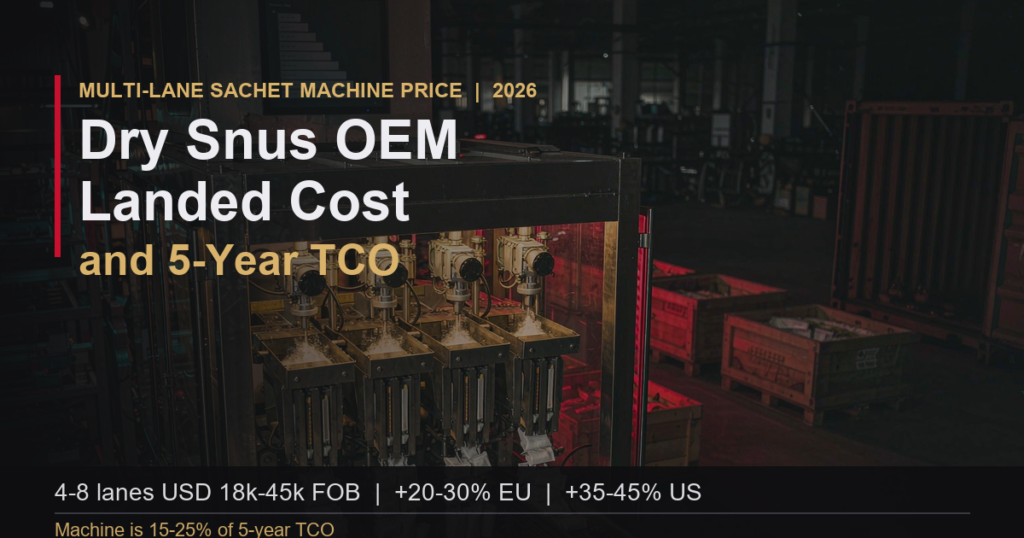
A multi-lane sachet packing machine for dry snus costs USD 18,000–45,000 FOB at 4–8 lanes, USD 35,000–80,000 at 8–12 lanes, and USD 60,000–150,000+ at 12–20 lanes. Budget another 20–30% on top for freight, duty and commissioning into the EU, or 35–45% for a Chinese-origin machine landed in the United States in late 2026. Over five years the machine itself is usually only 15–25% of total cost of ownership — operator labour and fill material are the rest. This guide breaks every one of those numbers down so an OEM buyer can turn three incomparable supplier quotes into one comparable landed-cost figure.
What does a multi-lane sachet packing machine cost in 2026?
Published 2026 price bands for VFFS sachet equipment, including oral pouch configurations, fall into six tiers. Lane count is the single biggest driver, because every extra lane needs its own dosing head, film path, sealing jaw set and servo axis.
| Configuration | Lanes | Speed | Price FOB (USD) |
|---|---|---|---|
| Semi-automatic single-lane | 1 | 10–30 sachets/min | 1,500 – 5,000 |
| Automatic single-lane VFFS | 1 | 30–80 sachets/min | 4,000 – 12,000 |
| Automatic multi-lane | 2–4 | 60–200 sachets/min | 8,000 – 25,000 |
| Production multi-lane | 4–8 | 150–400 sachets/min | 18,000 – 45,000 |
| High-speed multi-lane | 8–12 | 400–600 sachets/min | 35,000 – 80,000 |
| Industrial multi-lane | 12–20 | 600–1,000+ sachets/min | 60,000 – 150,000+ |
Real listings track these bands. A 20-lane snus packing machine with a 7-inch HMI and 30–45 bags/min/lane is quoted at USD 75,000 with 30-day delivery and T/T terms; multi-lane nicotine and snus sachet machines appear at USD 23,199 and USD 37,500–38,000; volume-tier pricing on one 17-year-old Guangdong line drops from USD 45,574 to USD 15,625 at ten sets or more. Treat the sub-USD 5,000 eight-to-ten-lane listings with suspicion — the next section explains why.
Which options move the quote, and by how much?
Once lane count is fixed, these are the line items that separate a USD 20,000 quote from a USD 45,000 quote on the same frame.
| Option | Typical added cost (USD) | What you actually get |
|---|---|---|
| Servo drives instead of pneumatic | +2,000 – 8,000 | Repeatable dose and jaw motion; the basis for ±1–2% fill accuracy |
| Four-side seal instead of back-seal pillow bag | +1,500 – 4,000 | Flat, retail-ready portion sachet |
| Nitrogen flushing | +1,500 – 4,000 | Oxygen barrier for shelf life |
| GMP / IQ-OQ-PQ documentation package | +2,000 – 8,000 | Weld maps, material certificates, calibration and validation protocols |
| Inline date and lot coding | +800 – 3,000 | Thermal transfer or inkjet printing on the film path |
| CIP and washdown package (moist product) | +2,000 – 6,000 | Spray heads, drainable frame, higher-grade contact surfaces |
Why is a USD 4,000 eight-lane listing not the same machine as a USD 38,000 one?
Read every accuracy claim as a percentage of your dose, never as an absolute gram figure. A listing advertising ±0.05 g sounds impressive until you divide it by a 0.5 g dry snus portion: that is ±10%, which is the same tolerance as a laboratory bench filler and roughly five times looser than a servo auger production head. A production machine specified at ±1–2% on 0.5 g holds 0.495–0.505 g.
The second difference is documentation. Cheap listings rarely include a CE technical file, EN 10204 3.1 material certificates for contact parts, weld records, or an IQ/OQ protocol. Those are the items a European or North American brand owner will ask for before they let your line make their product, and retrofitting them costs more than buying them up front.
What does it cost to land the machine at your factory?
FOB is not a budget. Here is what a USD 38,000 four-lane machine actually costs by the time it is making saleable pouches, using HS code 8422.40 (other packing or wrapping machinery).
| Destination | Duty on HS 8422.40 | Freight and insurance | Installation | Realistic add-on over FOB |
|---|---|---|---|---|
| European Union | 1.7% ad valorem, plus VAT 19–27% (recoverable if registered) | 20 ft container 1,500–5,000; marine insurance 0.2–0.5% of value | 5–15% of machine price | +20 – 30% |
| United Kingdom | 0% MFN, plus 20% VAT | Same routing as EU | 5–15% | +18 – 28% |
| United States | 3.8% MFN; Chinese-origin goods also carry Section 301 at 25% plus the two-tier surcharge introduced 24 July 2026 | West Coast 14–20 days ocean, 21–35 days door-to-door | 5–15% | +35 – 45% |
Worked example for northern Europe: USD 38,000 machine, USD 3,000 ocean freight, USD 150 insurance, 1.7% duty on a CIF of roughly USD 41,150 (about USD 700), USD 1,200 brokerage and handling, and USD 3,800 commissioning — a commissioned cost near USD 46,850, or 23% over FOB. The same machine into the US can clear USD 55,000 once the stacked tariffs are applied. US tariff treatment has been in flux through 2026, so have your broker confirm the stack before you sign, not after the vessel sails.
Does dry snus change the machine price compared with moist portions?
Yes, but less than most buyers assume. Dry portions run roughly 3–15% moisture while moist portions run 30–45%. The dry product does not need a washdown-rated frame, CIP spray heads or moisture-barrier sealing geometry, so you can drop the USD 2,000–6,000 washdown package. What you gain instead is a dust problem: dry blends generate fines, which means you should budget for dust extraction at the dosing head, anti-static handling on the film path, and tighter sealing-jaw temperature control, because fines trapped in the seal are the most common cause of leak rejection on dry lines. The frame, servo drives and control system are identical either way, which is why the dry-versus-moist delta is a few thousand dollars rather than a different class of machine.
What is the five-year total cost of ownership?
Modelled on a four-lane dry snus line running one shift, 250 days a year, at 400 pouches/min — about 48 million pouches per year.
| Cost category | Per year (USD) | Five years (USD) | Share |
|---|---|---|---|
| Machine, landed USD 47,000 on a 10-year book life | 4,700 | 23,500 | 9% |
| Preventive maintenance and wear parts, 5–10% of machine price | 2,400 | 12,000 | 5% |
| Energy, 5.5 kW drive plus compressed air, 2,000 h at USD 0.12/kWh | 1,500 | 7,500 | 3% |
| Operator labour, one per shift, fully loaded | 45,000 | 225,000 | 83% |
| Total machine-side TCO | 53,600 | 268,000 | 100% |
And then the number that reframes the whole purchase: 48 million pouches at 0.5 g is 24,000 kg of blend per year. At USD 60/kg that is USD 1.44 million of material a year, roughly 30 times the annualised cost of the machine. The machine is not the expensive part of making dry snus. The accuracy with which it doses your blend is.
Where does the money actually leak after installation?
- Overfill. Moving average overfill from +3% to +1% on the line above recovers about 480 kg of blend a year, roughly USD 28,800. Against that, the USD 2,000–8,000 premium for servo dosing pays back in seven weeks to four months.
- Film waste. A well-designed VFFS wastes 2–4% of film across starts, splices and rejects; a poorly designed one wastes 8%. On USD 100,000 of annual nonwoven spend, closing that gap is USD 5,000 a year.
- Downtime. If your line carries USD 5,000 of product value an hour, the difference between 95% and 98% uptime is 120 hours a year — USD 600,000. No purchase-price saving survives that.
- Accuracy drift. Dosing that starts at ±1% and drifts to ±3% because nobody re-checks after a film splice or a hopper refill quietly doubles your give-away.
What payment terms and Incoterms should an OEM buyer expect?
The market standard for Chinese-built pouch machinery is 30% deposit with the order and 70% before shipment by T/T, on FOB terms. FOB keeps your freight forwarder and destination logistics under your control while making the factory’s responsibility unambiguous. CIF adds ocean freight and insurance to the supplier’s scope; DDP adds destination duty and inland delivery and is the most expensive paper-free option. Insist on marine cargo insurance at 0.2–0.5% of machine value — it is cheap and it is the only thing standing between you and a crate that went overboard. For EU imports, require the CE declaration of conformity and the technical file at shipment, not at commissioning.
What should an RFQ specify so the quotes are comparable?
- Pouch dimensions and target fill weight, with the tolerance stated as a percentage, not grams
- Lane count and cycles per minute per lane, plus the OEE figure the speed assumes
- Blend moisture range, particle size and bulk density — dry and moist are different machines
- Film specification: nonwoven GSM, roll width, seal layer and seal temperature range
- Power supply and compressed air available at your site
- Scope of documentation: CE, material certificates, IQ/OQ, calibration certificates
- Incoterm, payment terms, warranty length and the spare-parts kit included
- What the FAT will test, and who supplies the 200–500 g of real blend and two production film rolls to run it
Send that list to three suppliers and the quotes come back within 10% of each other. Send a one-line “quote 4-lane nicotine pouch machine” and you get a spread of USD 30,000, because each supplier has quietly assumed a different machine.
What should you do next?
Decide the dose accuracy you need before you decide the lane count — on a dry snus OEM contract, the tolerance in your brand owner’s specification is the constraint that sets everything else. Then size lanes to your contracted annual volume rather than your ambition, and ask each supplier for a landed-cost quote, not an FOB quote.
Our engineering team builds nicotine pouch packaging machine and sachet and stick pack machinery configurations across the 2–20 lane range, and can quote either the machine alone or a complete OEM package. If you would rather not buy the asset at all, OEM pouch manufacturing lets you validate a market before committing capital. Send your pouch drawing, target dose and annual volume to contact our engineering team, or read more about PouchMfg to see how we build and support these lines.