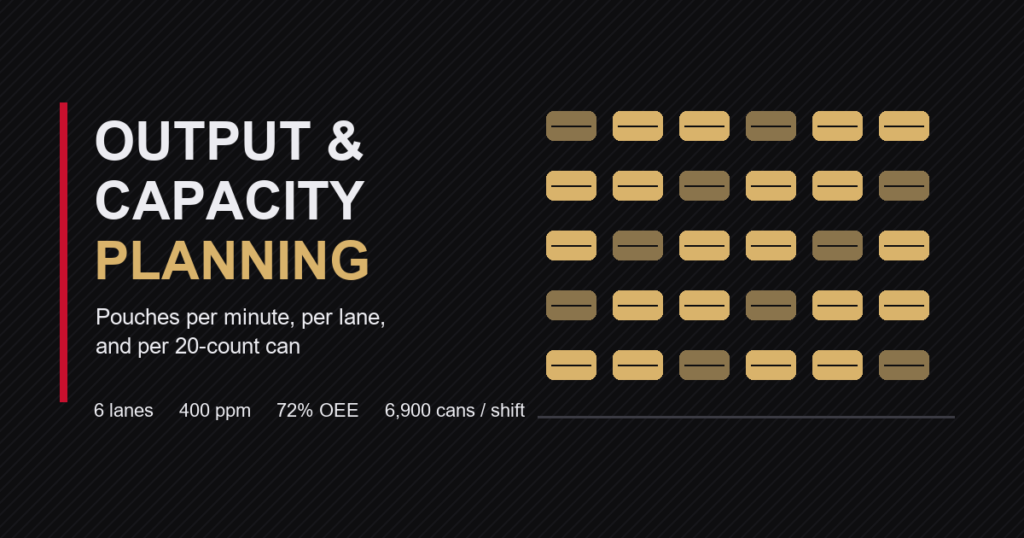
A 4-lane nicotine pouch packaging machine produces roughly 200–240 pouches per minute, a 6-lane machine runs 300–500 pouches per minute, and an 8-lane machine reaches 480–500 pouches per minute. High-end 10- and 12-lane platforms exceed 800 pouches per minute. In plain factory terms, a mid-range 6-lane line at 72% OEE fills about 6,900 cans of 20 pouches per 8-hour shift, or roughly 13,800 cans per day on two shifts. Below are the seven questions buyers ask most often when sizing a line, with the arithmetic behind every answer.
How many pouches per minute does a nicotine pouch packaging machine produce?
Output scales with lane count, but not linearly with cost. Here are the figures most builders quote for heat-sealed nonwoven pouches:
| Lane configuration | Total output (pouches/min) | Per-lane cycle rate | Theoretical pouches per 8-hour shift |
|---|---|---|---|
| 4-lane | 200–240 | 50–60 /min | 96,000–115,200 |
| 6-lane | 300–500 | 50–83 /min | 144,000–240,000 |
| 8-lane | 480–500 | 60–63 /min | 230,400–240,000 |
| 10–12-lane | 800–1,200 | 80–100 /min | 384,000–576,000 |
Those numbers are nameplate values measured with free-flowing dry product, a full film reel and no interruptions. Treat them as the ceiling, not the plan.
How many pouches come out of each lane?
Plan on 50–60 cycles per minute per lane for a conventional heat-seal platform, and 80–100 cycles per minute per lane on high-end servo platforms. The limit is not the motor; it is the sealing dwell time. A nonwoven pouch needs roughly 0.3–0.6 seconds of jaw contact at 140–180 °C to produce a peelable but airtight seam. Add indexing, cutting and discharge, and a cycle lands near one second per lane.
This is why a 12-lane machine is not simply three times a 4-lane machine in practice. You are multiplying the number of jaws, dosing heads and film paths that must all stay inside tolerance simultaneously.
How many cans per day can one line fill?
Use this formula: real output = lanes × cycles per minute × 60 × hours × OEE. Then divide by your pouch count per can.
| Line | Nameplate ppm | At 72% OEE (pouches/shift) | 20-count cans per shift | Cans per day (2 shifts) |
|---|---|---|---|---|
| 4-lane | 220 | 76,000 | 3,800 | 7,600 |
| 6-lane | 400 | 138,200 | 6,900 | 13,800 |
| 8-lane | 490 | 169,300 | 8,460 | 16,900 |
| 12-lane | 900 | 311,000 | 15,550 | 31,100 |
A downstream can-filling station for round cans typically runs 50–60 cans per minute with a multihead weigher, so check that your pouch machine output does not outrun the filler. One 12-lane line at full speed needs several can-filling stations in parallel.
Why does my real output differ from the spec sheet?
Overall equipment effectiveness (OEE) is where the gap lives. Expect 65–78% in the first six months, rising above 80% once operators and recipes mature. The main losses:
- Film reel changes — every 2–4 hours, costing 3–8 minutes each including splice and re-registration.
- Flavour and format changeovers — 30–90 minutes on a well-documented SOP, including purging the dosing system and re-verifying fill weight.
- Checkweigher rejects — typically 0.5–2% of pouches at ±1% dosing tolerance, higher during ramp-up.
- Start-up and warm-up — sealing jaws need 10–20 minutes to stabilise at temperature.
- Cleaning and sanitation — product-contact parts on moist snus lines need more frequent washdown than dry all-white lines.
Does a higher lane count always mean more pouches?
No. More lanes add four specific risks that eat the theoretical gain:
- Dosing drift — a 4-lane machine has four dosing channels; one channel out of tolerance puts 25% of output at risk. A 12-lane machine has twelve channels to keep calibrated.
- Wider film web — registration and tension control get harder as web width grows, and edge trim waste rises.
- Scrap during ramp-up — every start produces more rejects on a wide machine than a narrow one.
- Changeover cost — if you run more than three SKUs, a single wide line spends more time stopped than two narrower lines.
A practical rule: size lane count to your required annual volume plus 20–30% headroom, then check whether SKU count pushes you toward two lines instead of one wide line. A nicotine pouch packaging machine specified this way will hit its payback faster than a maximally wide line running at half load.
How do portion weight and moisture content change the speed?
Moisture is the single biggest product-side variable. Dry all-white portions at roughly 25% moisture flow freely through an auger and hold nameplate speed. Traditional moist snus at around 50% moisture bridges and rat-holes in the hopper, which is why those lines use heated or cooled agitators and non-stick coatings — and still run 20–30% slower.
Portion weight matters too. Filling 1.0 g instead of 0.5 g takes more auger revolutions per cycle; on a volumetric filler that can cost 10–20% of cycle rate. A gravimetric or multihead dosing system holds speed better across weights and reaches ±0.5% accuracy, compared with ±1–2% for volumetric augers.
Can one machine run 0.5 g mini portions and 1.0 g standard portions?
Yes, on the same platform, provided the dosing system covers both ranges and you budget for change parts and recipe re-validation. You will swap the auger or dosing cup, adjust sealing jaw settings if pouch dimensions change, and re-run fill-weight verification across all lanes before releasing the batch. That is a 30–90 minute job, not a rebuild.
What should I send a supplier to get an accurate output quotation?
Send these nine items and you will get a number you can hold the supplier to, rather than a marketing range:
- Pouch dimensions (length, width) and material — nonwoven GSM and whether it is heat-sealable.
- Target fill weight and tolerance (for example 0.5 g ±1%).
- Moisture content of the blend, in percent.
- Blend bulk density and flow behaviour, ideally with a sample for testing.
- Film roll spec — web width, outer diameter and core size.
- Pouches per can and target cans per minute downstream.
- Planned shifts per day and production days per year.
- Available utilities: 380 V three-phase power, 0.6–0.7 MPa compressed air, floor space and ceiling height.
- SKU count and expected changeovers per week.
Run the same list through a OEM pouch manufacturing partner if you plan to outsource before buying, so that your volume assumption is validated against a real production schedule.
Next step
Work backwards from annual can volume, not from machine speed. Convert cans to pouches, divide by your realistic OEE, and only then pick the lane count. If the arithmetic lands between two configurations, take the smaller one and spend the difference on a second downstream can filler or on gravimetric dosing — both protect output more reliably than extra lanes.
To have your volume assumption checked against machine data, contact our engineering team with the nine items above, or read more about PouchMfg and how we build and commission multi-lane pouch lines.