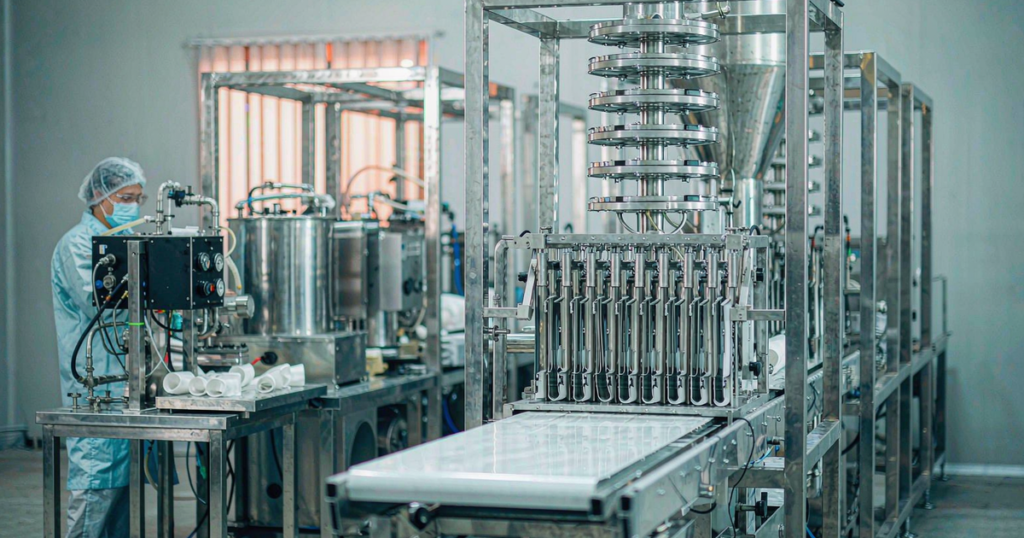
A nicotine pouch machine scale-up is the sequence that takes a formulation from a 0.4–0.6 g bench sample to a validated production line running 200–1,200 pouches per minute (ppm) across 4–12 lanes, with fill weight held at ±0.5–2% and every batch released against a written specification. Also called a pouch filling machine, a pouch making machine or an oral pouch machine, the hardware is only the last third of the job — the blend, the moisture target and the stability data decide whether the line can hold that tolerance at speed.
Brands typing Zyn pouch machine or snus machine into a search box are usually at step 3 of this sequence, not step 1. In the US the product is a nicotine pouch and the equipment is a pouch production line; in Sweden and the Nordics the same hardware is sold as a portion packing machine; in the UK and EU the compliant wording is tobacco-free nicotine pouch (TFNP) or modern oral. Same machine, three different purchase-order languages, and the spec sheet you sign should use the one that matches your market.
What does scale-up actually mean for a nicotine pouch line?
Scale-up means proving three things in a fixed order: that the blend can be dosed to a repeatable fill weight, that the sealed pouch stays stable for the full labelled shelf life, and that the same result repeats at commercial speed. Skipping the middle step is the single most common cause of a line that passes factory acceptance and then fails its first production month.
The three checkpoints map to three machine classes. A lab-scale unit is not a toy — it exists so that R&D can lock forming, sealing and dosing parameters without booking time on the machine that is supposed to be shipping orders.
| Stage | Typical output | Fill range | Moisture range | What it is for |
|---|---|---|---|---|
| Lab-scale / pilot machine | 25–45 ppm | 0.4–0.6 g | 3–45% | Samples, method development, parameter lock |
| Single-lane production machine | 180–300 ppm | 0.4–0.6 g | 3–40% | Launch volumes, one SKU at a time |
| Multi-lane production line (4–12 lanes) | 200–1,200 ppm | 0.2–2.0 g | dry to moist | Brand-scale output, canning at 50–60 cans/min |
Ultrasonic sealing is the default for non-woven fleece because it welds the web without scorching the blend. That is not universal: ultrasonic sealing is not the right choice for heat-sealable laminate films — in that case heat sealing gives higher throughput and a wider sealing window. Lock this decision on the pilot machine, not after the production line is crated.
Step 1–2: how do you lock the formulation and the written spec?
Before any metal is cut, the specification has to exist on paper. In practice it lists:
- Format — Mini 0.4–0.5 g, Slim 0.65–0.75 g or Large ~1.0 g.
- Strength — stated as mg per pouch (typical ladder 1.5 / 3 / 6 / 9 / 11 mg), which is not the same number as mg per gram of blend.
- Moisture and water activity — a dry pouch sits around 25% moisture with a 12–18 month shelf life; a moist portion runs near 50% and needs chilled distribution of roughly 3–4 months.
- Count per can — 20–25 pouches for a standard can (a tin, in UK English).
- pH and release profile — the weak-alkaline buffer that sets how fast nicotine releases.
Supplier approval comes before material is used, and it is reviewed annually. Skipping that review is how a batch fails a heavy-metals panel six weeks after the cans are printed.
Step 3: should the pilot run on your own machine or at a contract manufacturer?
This is the fork that decides your capital path. A contract packer already holds an FDA-registered, GMP-assessed facility and can turn a signed-off formula into canned goods in roughly 3–5 weeks, with MOQs commonly quoted at 5,000 cans per order in China and about 10,080 cans in Sweden. White label (an existing stock formula under your brand) is the fastest route; private label (your own formula, exclusive) costs more time and carries a higher MOQ; contract manufacturing means you bring the formula and they run it.
The trade-off is control against speed. If your plan is to own the margin on volume, you buy the machine and treat the contract run as the bridge that keeps shelves filled while the line is being built. If your plan is to test two or three flavours in one market first, stay with the contract packer and revisit equipment after you see reorder data.
Either way, ask for retained samples — three per batch is standard — held for shelf life plus one year. You will need them the first time a retailer challenges a batch.
Step 4: which stability and release tests gate the first pallet?
Testing is where most schedules slip, because a real-time stability study runs as long as the shelf life you want to print. Accelerated studies get you an interim answer; they do not replace the real-time data that sets the date on the lid.
| Test | Method / basis | Why it gates release |
|---|---|---|
| Nicotine assay | HPLC | Confirms mg per pouch matches the label; the number a regulator checks first |
| Fill weight | In-process checkweigher, ±0.5% with a multi-head weigher | Fill weight is what converts mg per gram into mg per pouch |
| Moisture and water activity | Loss-on-drying / aw meter | Drives shelf life, mouthfeel and clumping in the hopper |
| Seal integrity | Non-destructive seal test | A leaking pouch is a complaint, not a defect you can rework |
| Microbiology | TVC, yeast, mould, named pathogens | Required for release in most markets |
| Heavy metals | Pb, Cd, Hg against UK/EU limits | Fails on the raw material, not the machine — but it fails your batch |
| Child-resistant closure | ISO 8317 | Mandatory for can closures in most retail channels |
Every batch should ship with a certificate of analysis (CoA) and a batch release confirmation. If you are filing into the US, the lab needs methods developed specifically for the pouch matrix — generic tobacco methods produce results that do not survive review, and re-running a study costs more than doing it once correctly.
Step 5–6: how do pilot parameters become a machine specification?
Whatever the pilot machine achieved becomes the acceptance criteria on the production line. The four parameters that matter are fill weight and its tolerance, seal temperature or ultrasonic amplitude and dwell time, web tension on the non-woven, and the moisture window the dosing system was validated in.
Be explicit about the moisture window. A dry 25%-moisture blend flows through an auger filler or a multi-head weigher very differently from a 50%-moisture portion blend that needs a push-feeder to stop it sticking. A line configured for one will not simply run the other without a change of dosing hardware and, in most cases, a change of sealing parameters.
Step 7: what does installation and commissioning actually involve?
Budget the site before the machine arrives. A multi-lane line typically needs 380 V three-phase power, compressed air at 0.6 MPa (about 6 bar) with 300–600 L/min depending on lane count, and a humidity-controlled room so the blend does not pick up moisture in the hopper.
| Phase | Typical duration | Deliverable |
|---|---|---|
| Machine build and factory test (FAT) | 45–60 days standard, 75–90 days for a turnkey line | FAT report, running video, punch list |
| Shipping and customs | 3–6 weeks by sea, depending on lane | Packing list, CE documentation |
| Mechanical install | 4–6 days | Levelled, wired, air-connected |
| Commissioning and SAT | 4–6 days | Site acceptance at agreed ppm, fill weight and seal quality |
| Operator training and SOP handover | 2–3 days | Trained operators, recipe storage populated |
What are the real MOQs, lead times and sample costs?
Indicative figures quoted across the contract-manufacturing market in 2026: stock samples ship in days for a handling fee around USD 150, custom samples of your own formula run USD 150–300, MOQs start near 3,000–5,000 cans per flavour (some suppliers ask for 5 SKUs minimum), and the full path from formula sign-off to first shipment lands somewhere between 2 and 12 weeks depending on whether you are white-labelling or developing a formula from scratch. Treat these as planning numbers, not quoted prices — they move with flavour count, can artwork and market compliance.
When is scale-up the wrong move?
Scale-up is the wrong move if you have not yet sold a single can. Buying a 12-lane line before you have reorder data converts a marketing question into a fixed-cost problem, and a line that runs one shift a week never reaches the OEE that justified the purchase. The cheaper sequence is contract run first, then equipment once volume is proven — the pilot data you generate is exactly what the machine specification needs, so nothing is wasted.
What should you send a machine supplier to get an accurate quote?
Nine items, and the quote is only as good as the brief:
- Format (Mini / Slim / Large) and target fill weight in grams
- Target output in pouches per minute, and cans per day
- Moisture range of the blend, or dry versus moist
- Non-woven specification — GSM, width, roll core diameter
- Sealing preference, or ask for both ultrasonic and heat-seal evaluation
- Pouches per can and can dimensions
- Available utilities — voltage, phases, compressed air, room humidity
- Downstream scope — can unscrambler, pouch-to-can loader, checkweigher, metal detector, vision inspection, cartoning
- Compliance target — CE, ISO 9001, GMP, FDA-registered facility, PMTA documentation support
Most delays we see at this stage come from item 3 and item 7, not from the machine itself.
Where to start
If you are still at the sample stage, the fastest low-risk path is to lock parameters on a lab-scale nicotine pouch packaging machine before committing to lane count. If you need volume while the line is built, an OEM pouch manufacturing partner bridges the gap. For a line specification review, contact our engineering team with the nine items above — and if you also run powders, granules or liquids, the same sachet and stick pack machinery principles apply to dosing and sealing. Read more about PouchMfg and how we build lines around validated parameters rather than catalogue speeds.