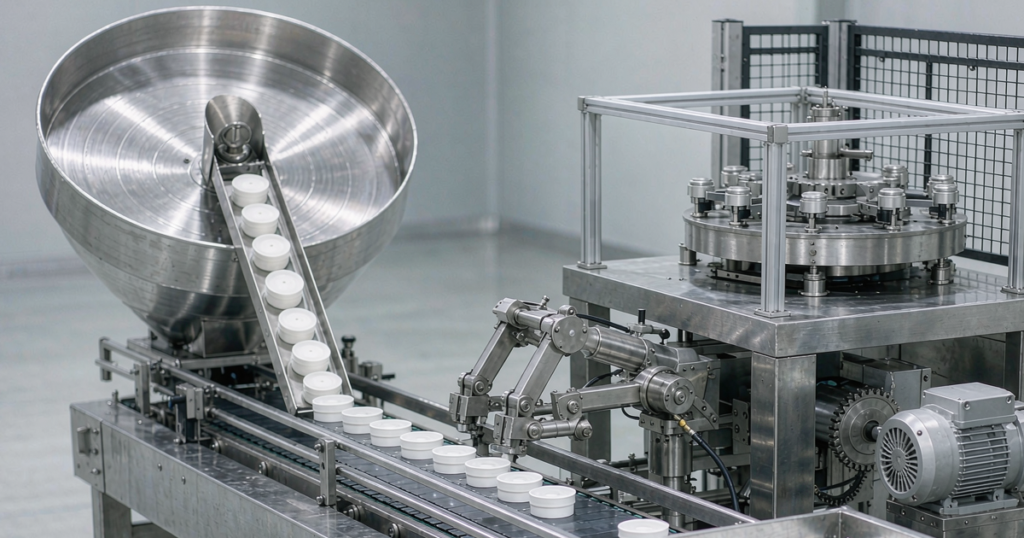
A nicotine pouch machine canning line is the secondary packaging section that counts finished pouches, loads them into rigid cans at 50–70 cans per minute, then caps, seals, labels and inspects each can. Also called a pouch-to-can line, a can filling line or — in the UK and Nordic markets — a tin line, it sits directly downstream of the multi-lane pouch maker that forms and doses the pouches themselves.
Pouches arrive from the primary machine at 200–1,200 pouches per minute. At the standard 20 pouches per can, a 6-lane machine running 400 ppm needs the canning section to deliver 20 cans per minute; a 12-lane machine at 1,000 ppm needs 50 cans per minute. Sizing the canning section to the pouch maker — and not the other way round — is the specification most buyers get wrong on their first line.
Searchers also use “Zyn can line”, “snus canning machine” and “pouch can packing machine” for the same equipment. In the US the container is a can; in the UK it is usually called a tin; in Sweden the whole section is often called the portion canning line. Below are the six terms you will meet in every serious quotation.
What is a nicotine pouch machine canning line?
A canning line is everything between the pouch maker outlet and the case packer. Its job is counting, containment and compliance: it turns a continuous stream of loose non-woven pouches into a sealed, labelled, batch-coded retail unit that passes child-resistant testing and carries a traceable code. The pouch maker is rated in pouches per minute (ppm); the canning section is rated in cans per minute (cpm). Those two numbers are related by the count per can, not by the machine price.
| Station | What it does | Typical rating | What to specify |
|---|---|---|---|
| Can unscrambler | Orients bulk empty cans mouth-up and meters them out | 120–150 cans/min bowl feed | Can diameter and height range, hopper capacity, quick-change tooling |
| Pouch collector and loader | Counts 20–25 pouches and inserts the stack into the can | Matched to pouch maker output | Count per can, counting method, short-count reject logic |
| Desiccant feeder | Drops a moisture-control sachet into the can | Optional station | Only for moist portions or hygroscopic blends |
| Capping machine | Places and tightens the lid to a recorded torque | 40–60 caps/min, up to 750 on rotary chuck cappers | Chuck or spindle, application and removal torque, CR certification |
| Induction sealer | Bonds the foil liner to the can rim for a tamper-evident seal | 26–100 kHz, 0.5–5 kW | Liner type, rim compression, cooling and conveyor speed |
| Checkweigher + metal detector + vision | Rejects off-weight cans, metal fragments and bad labels | Full-line speed, 100% inspection | Tolerance band, reject handling, data logging for batch records |
Term 1: can unscrambler (can feeder, bowl feeder)
The unscrambler takes empty cans from a bulk hopper, orients them mouth-up and meters them onto the conveyor at a controlled rate. Modern bowl feeders on oral pouch lines are rated at 120–150 cans per minute, deliberately faster than the filling station: the bowl acts as a buffer so the loader never starves. Specify the can diameter and height range, hopper capacity in cans, and whether you need quick-change tooling for a second can format before you sign.
Term 2: pouch collector and pouch-to-can loader
This is the interface machine, and the one that sets your real line rate. It counts a fixed number of pouches — 20 for a standard can, 21–25 for slim and regular formats, more for large-capacity cans — collates them into a stack, and inserts the stack into the open can below with a sliding tray or a pick-and-place head. Miscounts here are the single biggest source of short-fill complaints from retail buyers, so ask for the counting method (vision, weight, or mechanical pocket) and the reject logic when a count comes up short.
Term 3: desiccant feeder — when do you actually need one?
An optional station that drops a small sachet into the can before capping. It earns its place on moist portions and on formulations with volatile flavour top-notes; it is usually unnecessary on dry tobacco-free pouches that already carry a 12–18 month shelf life. If the blend is hygroscopic or the distribution chain runs through humid climates, specify it — retrofitting a feeder onto a built line is far more expensive than ordering it in the first time. Nitrogen flushing works on the same logic: useful for oxygen-sensitive blends, not worth the running cost on a stable dry formulation.
Term 4: capping machine — pick-and-place, chuck capper or spindle capper
A pick-and-place unit puts the lid on; the tightening method is where quotations diverge. A chuck capper lowers a lined chuck over the lid and rotates it to a set torque, then a clutch or servo releases — it gives the tightest, most repeatable torque and handles child-resistant and flip-top closures. A spindle capper, also called a roller or disc capper, spins the lid on with pairs of rotating silicone discs as the can travels past: higher throughput, looser torque control. A widely used field rule is that application torque in inch-pounds is roughly half the cap diameter in millimetres, so a 38 mm closure lands around 17–26 in-lb, with removal torque immediately after capping about half the applied value. Use the closure supplier’s validated figure, not the rule of thumb.
Term 5: induction sealer and tamper evidence
An induction sealer passes capped cans under a coil radiating a high-frequency field, typically 26–100 kHz from a 0.5–5 kW solid-state generator. The field induces eddy currents in the aluminium foil layer of the liner; the heat melts the polymer sealant, which bonds to the can rim and leaves a hermetic, tamper-evident membrane after the cap is removed. The process is non-contact, but it needs firm liner-to-rim compression — which is exactly why application torque one station upstream is not a cosmetic setting.
Term 6: checkweigher, metal detector and vision inspection
Three inspection stations close out the line. A checkweigher rejects cans outside the declared net weight band; a metal detector catches fragments from cutters and tooling; vision inspection verifies label position, print legibility and batch code presence. On regulated products these are not optional extras — they are the evidence pack behind your certificate of analysis and batch release records. Combine them with recipe storage on the PLC + HMI so each SKU carries its own tolerance set.
How many cans per minute should the downstream run?
| Pouch maker | Pouches/min | Cans/min at 20-count | Cans per 8-hour shift at 85% OEE |
|---|---|---|---|
| 4 lanes | 200 ppm | 10 cpm | 4,080 |
| 6 lanes | 400 ppm | 20 cpm | 8,160 |
| 8 lanes | 600 ppm | 30 cpm | 12,240 |
| 12 lanes | 1,000 ppm | 50 cpm | 20,400 |
| 12 lanes, high speed | 1,200 ppm | 60 cpm | 24,480 |
Two things follow from that table. First, a 15 cpm canning module bolted onto a 1,200 ppm pouch maker caps your whole investment, not just the cans. Second, buffer capacity between the two sections — an accumulation table and a controlled-stop handshake — is worth more than another 10 cpm of rated speed.
Child-resistant cans: what FDA and PPPA expect from your capper
In the United States, nicotine pouches are regulated as tobacco products, which means a PMTA and packaging that discourages accidental ingestion by children. Child-resistant reclosable packages are tested to ISO 8317 and to the US 16 CFR 1700 series under the Poison Prevention Packaging Act. Health warnings must cover roughly 30% of the two principal display panels. Practically, that means your capper has to hold a validated, recorded torque — and your labeler has to place a warning label within a tolerance you can prove. If you sell into the EU too, build in tobacco-free wording for the UK and modern oral markets, because snus as a term is restricted outside Sweden.
When a canning line is the wrong answer
Below roughly 150,000–250,000 cans a year, buying the cans yourself is usually the wrong decision: the unscrambler bowl, the change parts, the inspection stations and the second operator cost more per can than a contract packer charges. Start with a OEM pouch manufacturing partner, prove the SKU, then move the volume in-house once the count is stable. A canning line is also a poor fit if you intend to ship flexible formats — stand-up pouches and flow-wrapped bricks need a completely different secondary section.
What to send your machine supplier before you ask for a quote
- Can drawing: diameter, height, material, lid type and whether it is child-resistant certified.
- Count per can per SKU (20, 21, 25 or other) and target cans per minute.
- Pouch maker output in ppm, and lane count, so the two sections can be matched.
- Can supply format: bulk in cartons or on trays — this sizes the unscrambler hopper.
- Whether you need a desiccant feeder or nitrogen flushing, and the reason.
- Closure torque specification from your lid supplier, plus the removal-torque check method.
- Label plan: side, top, bottom, and the warning-label coverage rule for your market.
- Inspection requirements: checkweigher, metal detector, vision, and the reject handling you want.
- Utilities on site: voltage and phase, compressed air at 6 bar, and available floor length.
Frequently asked questions
Is a canning line the same thing as a nicotine pouch packaging machine?
No. The nicotine pouch packaging machine — the multi-lane form-fill-seal unit — forms the non-woven pouch, doses 0.4–0.75 g of blend and seals it at 200–1,200 ppm. The canning line counts those pouches into cans and closes them. Both are part of one pouch production line, and they are quoted as separate sections.
Can one canning line handle mini, slim and large formats?
Yes, if you buy the change parts. The variables are the collating pocket for the pouch stack, the count per can and the can itself. Tool-free format change is worth paying for: a contract packer running four SKUs per shift will lose more output to changeovers than to breakdowns. See our sachet and stick pack machinery for the primary side of the same line.
What does a complete canning section cost?
Budget it as a section, not as a machine: unscrambler, loader, capper, sealer, labeller and inspection, plus integration and FAT. Integration and commissioning routinely add 20–35% to the hardware number, and that is before installation and SAT at your plant. A nicotine pouch packaging machine quotation that only prices the pouch maker is not a line quotation.
Ready to size the downstream properly? Send the nine items above to contact our engineering team and you will get a matched pouch-maker-to-canning specification back, in ppm and cpm rather than in adjectives. Read more about PouchMfg and how we build GMP-ready oral pouch lines.