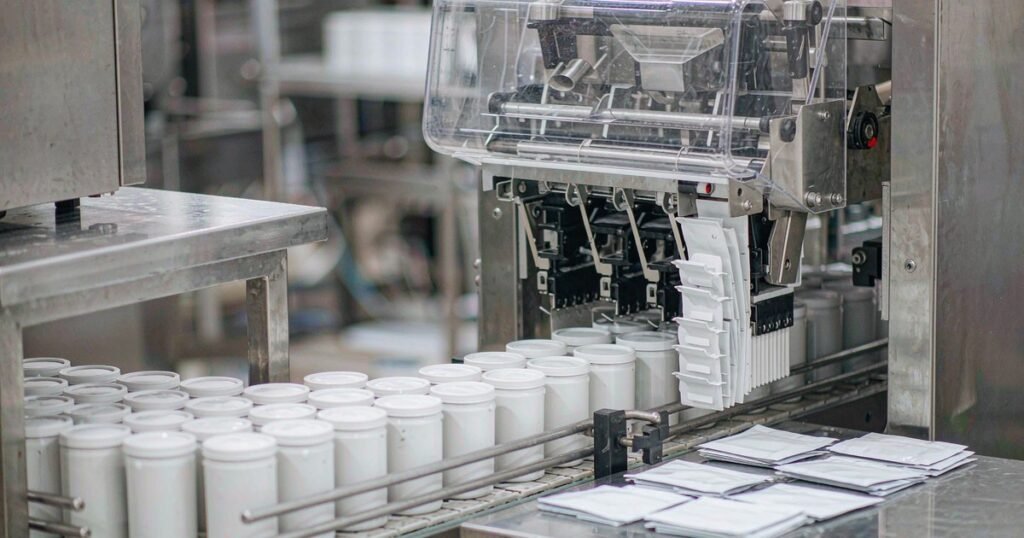
A nicotine pouch machine pays for itself in weeks of full-speed output — the real ROI question is how many cans per day you can sell, not how fast the line runs. A six-lane pouch machine at 600 pouches per minute fills about 13,500 cans in a single 7.5-hour shift, while the payback math for a USD 120,000 complete line needs only around 80,000 cans at a USD 1.50 contribution margin per can. Also called a pouch filling machine, a pouch making machine, a portion packing machine (Scandinavia) or an oral pouch machine (UK), this equipment is almost never the bottleneck in a return-on-investment calculation — sell-through, compliance cost and marketing spend are. Below is the full break-even math, with verified 2026 wholesale and production numbers.
How many cans per day does one line actually produce?
Output depends on lanes, pouch weight and shift length. A single shift of 450 productive minutes at 600 ppm yields 270,000 pouches; at 20 pouches per can that is 13,500 cans per shift.
| Line configuration | Speed | Pouches per shift (450 min) | Cans per shift (20/can) |
|---|---|---|---|
| 4-lane, 0.5 g mini pouches | 200–240 ppm | 90,000–108,000 | 4,500–5,400 |
| 6-lane, slim 0.65–0.75 g | 300–600 ppm | 135,000–270,000 | 6,750–13,500 |
| 8-lane, slim | 480–500 ppm | 216,000–225,000 | 10,800–11,250 |
| 10–12 lane high-speed line | 800–1,200 ppm | 360,000–540,000 | 18,000–27,000 |
Two caveats matter. First, the canning segment (can unscrambler, pouch-to-can loader, capper) is rated in cans per minute, typically 50–60 cans/min, and must be matched to the pouch segment — a 1,200 ppm pouch machine paired with a 15 cpm canning module throttles the whole line. Second, an untrained crew typically runs a new line at only 60–70% of rated speed for the first weeks, so plan break-even on conservative output.
What does a nicotine pouch machine cost in 2026?
Equipment price tiers for a tobacco-free nicotine pouch (modern oral) line, verified against current supplier quotations:
| Equipment level | Typical price (USD) | Suits |
|---|---|---|
| Single-lane servo pouch machine | 5,000–20,000 | Pilot batches, R&D, sample runs |
| Semi-automatic line with secondary packaging | 20,000–80,000 | Regional brands, 1–2 SKUs |
| Complete multi-lane line incl. canning | 80,000–150,000+ | Contract packers, national rollout |
| Full GMP facility (mixing, QC lab, line) | 3.5–8 million | US domestic production for PMTA holders |
The machine price is a rounding error next to the full-plant figure, which is exactly why the machine alone never decides ROI.
What is your contribution margin per can?
A manufacturer selling at wholesale keeps the difference between the wholesale price and the all-in production cost. Verified 2026 reference points:
– Wholesale price: USD 4.49–5.99 per 20-count can for US value and mid-tier brands (ZYN turns fastest at the thinnest margin; VELO, on! and ZIMO compete below it); UK wholesale runs GBP 2.20–3.50 per can with retail at GBP 5.49–6.99.
– Production cost: roughly USD 0.65–1.40 per can. Turning Point Brands publicly estimated USD 1.40 per can for air-freighted overseas production (about USD 1.00 contract manufacturing plus USD 0.20–0.25 air freight plus a 16 percent tariff) versus about USD 0.65 achievable with domestic US machinery.
– Own-line running cost: USD 0.07–0.17 per can for spare parts, energy and maintenance on a six-lane line, on top of materials.
– Materials dominate COGS: for a can of 20 pouches, packaging is about 30 percent, nicotine salts 25 percent, manufacturing 20 percent, flavorings 10 percent, logistics 15 percent. White-label finished cans are quoted around EUR 1.00 plus EUR 0.03–0.10 labeling at MOQs of 5,000–10,080 cans per SKU.
Net contribution per can for a brand operating its own line therefore lands in the USD 1.00–2.50 range; USD 1.50 is a fair planning midpoint.
How many cans per day to break even?
Break-even on the machine itself:
Cans to repay the machine = machine price / contribution margin per can
A USD 120,000 line at USD 1.50 per can needs 80,000 cans — six production shifts of output. But the number that decides whether the business survives is the monthly fixed-cost break-even:
Cans per day = monthly fixed overhead / (contribution per can x 30)
| Monthly fixed overhead (rent, staff, compliance, marketing floor) | Cans per month at USD 1.50 | Cans per day |
|---|---|---|
| USD 8,000 | 5,300 | ~180 |
| USD 18,000 | 12,000 | ~400 |
| USD 40,000 | 26,700 | ~890 |
So the honest answer for most small brands: somewhere between 180 and 900 cans per day of sell-through covers the overhead, and anything the line produces above that is payback. Marketing alone consumes 15–18 percent of revenue in this category, which is why overhead is rarely as low as founders first model.
How long is the machine payback period?
Machine-level payback under different sell-through assumptions:
| Line | Capex | Cans to repay (at USD 1.50) | Sell-through | Payback |
|---|---|---|---|---|
| Single-lane servo | USD 15,000 | 10,000 | 300 cans/day | ~33 days |
| Semi-automatic line | USD 50,000 | 33,300 | 800 cans/day | ~42 days |
| Six-lane complete line | USD 120,000 | 80,000 | 2,000 cans/day | ~40 days |
| Multi-lane + automated canning | USD 150,000 | 100,000 | 5,000 cans/day | ~20 days |
Every scenario repays the machine in one to two months of full sell-through. Industry analysis of branded nicotine pouch investments, however, puts realistic payback at 3–5 years with net margins of 10–18 percent. The gap between those two numbers is the entire business: distribution ramp, slotting fees for convenience-store shelf space, excise tax structures, and PMTA compliance. In the US, no FDA marketing authorization means no sell-through at all — the payback clock does not start until authorization lands, and supplemental PMTAs are required whenever pouch count per can or packaging configuration changes.
When does buying a machine not pay off?
A boundary worth stating plainly: below roughly 150,000–250,000 cans per year of projected volume, owning a line loses to contract-packed finished cans on every payback metric. White-label and private-label OEM finished cans at USD 1.10–1.90 per can (China, MOQ from 5,000 cans) or EUR 1.00+ per can (EU/Nordic suppliers, MOQ 10,080 cans per SKU) carry zero capex, zero maintenance and zero idle capacity. Buy the machine when your own sell-through forecast clears that threshold for two consecutive quarters — not before. A canning line, in particular, is a second purchase: it improves economics only once pouch volume already justifies in-house can filling.
What moves ROI the most after installation?
Three levers outperform everything else once the line runs:
1. Dosing accuracy. At a minimum excise duty of EUR 30–50 per kilogram of nicotine (EU vote pending) or per-kilogram state taxes, a ±2 percent auger overfill is a permanent tax on giveaway. Moving from a standard auger (±1–2 percent) to a multi-head weigher (±0.5 percent) can save tens of thousands of euros per year at scale.
2. OEE. Lifting overall equipment effectiveness from 40–60 percent to 70–85 percent through trained operators, recipe storage and tool-free changeover adds output without adding a single dollar of capex.
3. Changeover time. Fifteen to twenty minutes between mini and slim formats instead of a shift’s worth of mechanical adjustment is the difference between serving three strengths and serving one.
Frequently asked questions
How many cans per day is realistic for a new brand in year one?
Most independent retail accounts turn a case in about three weeks; a regional distributor signing ten stores at ten cans per store per week starts near 1,000 cans per month, not per day. Model year one at 100–500 cans per day and you will rarely be disappointed.
Does a faster machine improve ROI?
Only if sell-through is capacity-constrained. A 1,200 ppm line sitting at 20 percent utilization has worse ROI than a 300 ppm line running two shifts. Speed pays back through labor cost per can, not through the speed itself.
Is the machine payback the same as business payback?
No. Machine payback assumes every can produced is sold at contribution margin. Business payback includes formulation R&D (about EUR 150 per SKU), regulatory documentation, marketing and channel costs — which is why branded ventures historically take 3–5 years while the machine itself is repaid in weeks.
Do I need PMTA approval before the ROI math means anything?
In the US, yes. FDA marketing granted orders — 67 products authorized as of late 2026 across ZYN, VELO and on! — are the gate. In markets without product authorization regimes, the equivalent gate is excise registration and import licensing.
Ready to run the numbers on your own volume? Send your target cans per day and pouch format to contact our engineering team and we will return a line configuration with the payback math filled in. To compare the make-vs-buy decision first, read about our OEM pouch manufacturing and white-label options, or browse the nicotine pouch packaging machine range. Learn more about PouchMfg on our about page.