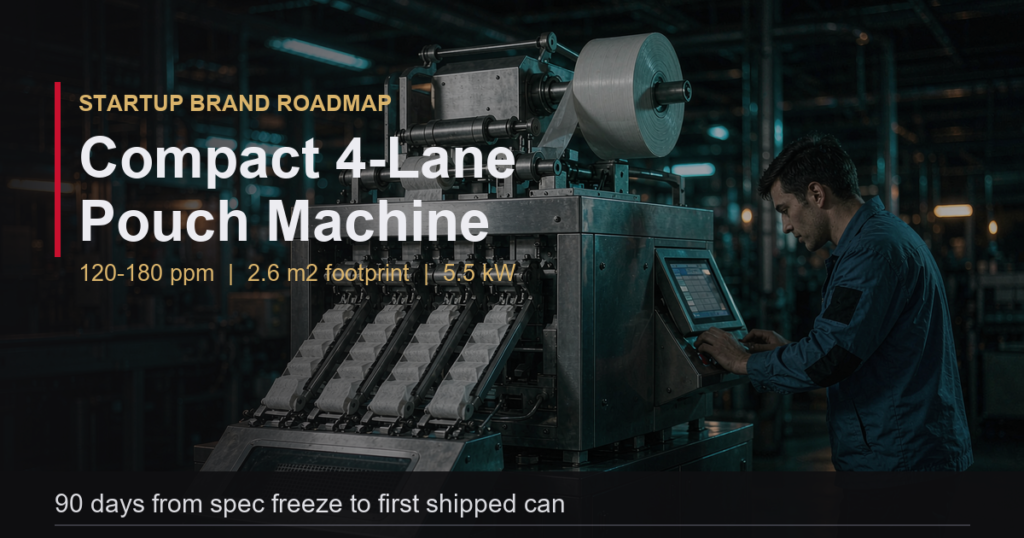
A compact 4-lane pouch machine is the smallest machine class that can carry a commercial nicotine pouch launch on its own: four filling lanes, a footprint of roughly 2,200 × 1,200 mm, about 600 kg of machine weight, 5.5 kW installed power, and an output of 120-180 pouches per minute at 30-45 cycles per minute per lane. At 85% OEE that is 49,000-73,000 pouches per eight-hour shift, or roughly 2,450-3,670 cans per shift at 20 pouches per can. A 10,000-can first order is about four shifts of work.
That number matters because it decides the whole roadmap. Most startup brands begin by toll-packing through a contract manufacturer, validate demand, and only then buy. A single-lane or two-lane machine cannot absorb a real launch order; a 4-lane compact can. This is the 90-day path from freezing your specification to shipping your first pallet on your own line.
What can a compact 4-lane machine actually produce?
The honest answer is a narrow but genuinely commercial window. Machines in this class are built around a volumetric cup or short auger filler, a vertical form-fill-seal column set, and heat or ultrasonic sealing jaws.
| Parameter | Typical compact 4-lane range | Why it matters to a startup |
|---|---|---|
| Lanes | 4 | Lowest lane count that still ships a launch order |
| Speed | 30-45 cycles/min/lane (120-180 ppm) | 49,000-73,000 pouches per shift at 85% OEE |
| Fill weight | 0.4-0.6 g | Covers standard 0.5 g portions; 0.7 g may need a different auger |
| Dosing accuracy | ±1%-2% with servo auger; up to ±10% with a plain measuring cup | Directly sets your nicotine compliance margin |
| Pouch size | Length 40-120 mm, width 20-60 mm | Enough for portion sachets, not for stick packs |
| Seal width | 4 mm longitudinal, 5 mm transverse | Wider seals eat film and shorten the roll change interval |
| Material moisture | 10%-45% | Handles both dry and moist portions on one platform |
| Footprint / weight | 2,200 × 1,200 × 1,800 mm / ~600 kg | Fits a 2.6 m² bay; most industrial floors carry it without reinforcement |
| Utilities | 220/380 V 3-phase, 5.5 kW; compressed air 0.6-0.8 MPa | A single air compressor and one 3-phase drop is usually enough |
The trade-off is accuracy. The entry configuration of this class uses a measuring cup, and published accuracy for that filler is around ±10%. If your market has a hard per-pouch nicotine ceiling, budget for a servo auger and a checkweigher from day one rather than retrofitting in month six. See our breakdown of nicotine pouch packaging machine dosing options before you sign.
Should a startup brand buy a 4-lane machine, or keep toll-packing?
Buy when three conditions are true at the same time: you have sold through at least one full contract run, you have a second market or a second SKU that will consume capacity, and your monthly volume is within roughly 30% of the machine’s single-shift output. If any one of those is missing, toll-packing is still cheaper.
The cost side is well documented for 2026. A single-SKU pilot launch of 10,080 cans runs to about EUR11,600 including brand design, R&D, SDS documentation and labelling; a four-SKU rollout of 40,320 cans is around EUR44,000. Contract manufacturers in Europe quote minimums from 2,000 cans and production of up to 30 days after sample and artwork approval. That is a very low-risk way to learn whether anyone actually reorders.
Where the arithmetic turns is contribution per can. At 20 pouches per can and 49,000 pouches per shift, one machine produces about 2,450 cans per shift. Toll fees in the EUR0.12-0.20 per can range plus your own margin are what you are replacing. Once you are consistently above roughly 50,000 cans per month, the fixed cost of an owned line stops being the expensive option.
What must be frozen before you place the order?
Most first-time delays come from an unfrozen specification, not from manufacturing. Freeze these eight items and put them in the purchase contract as an annex:
- Target fill weight and tolerance – 0.5 g at ±1% is a different machine from 0.5 g at ±10%.
- Pouch dimensions and material – nonwoven GSM, seal layer, and whether you need PLA/PBAT compostable film.
- Moisture range – dry at 8-15% or moist at 30-45%; this changes the filler and the cleaning method.
- Sealing technology – heat sealing for laminates, ultrasonic for nonwoven-only constructions.
- Can count and can diameter – 15 or 20 pouches per can, and whether canning is manual or automatic this year.
- Utilities available on site – voltage, phase, compressed air, floor loading, door width for a 1,200 mm frame.
- Documentation package – CE, material certificates, calibration certificates, and the language of the manuals.
- Acceptance criteria – the exact numbers the machine must hit at FAT, and with whose material.
How does the 90-day roadmap actually run?
Days 1 to 30 are specification, contract and build. Days 30 to 60 are factory acceptance, shipping and site preparation. Days 60 to 90 are installation, commissioning and the first commercial batch. Shipping alone can consume three to five weeks to Northern Europe or four to six weeks to the US East Coast, so site preparation has to happen while the machine is on the water, not after it lands.
Days 1-30: freeze, contract, build
Sign the specification annex, pay the deposit, and send 200-500 g of real production blend plus two full rolls of production film to the factory. Machines tested with substitute powder and generic film behave differently on day one.
Days 30-60: FAT, ship, prepare the site
Run the factory acceptance test against your frozen numbers, not the supplier’s defaults. Then finish the floor, power, air and drainage while the container moves.
Days 60-90: install, commission, first batch
Mechanical installation of a single compact machine is typically two to five days, followed by commissioning: recipe setup, dosing calibration lane by lane, seal integrity checks, and a pilot run. Expect 5,000-20,000 pouches of pilot output before anything is saleable.
What does factory acceptance look like for a first-time buyer?
A FAT is not a demonstration video. It is a signed protocol with numbers. For a compact 4-lane machine, insist on the following, run with your material and your film:
- Dosing check – at least 30 consecutive pouches per lane weighed on a 0.001 g balance; record mean, range and standard deviation.
- Seal integrity – pull test or dye-penetration on samples from every lane, not just lane one.
- Sustained run – a continuous run long enough to see a roll splice and a film end, because that is where most of your scrap happens.
- Changeover timing – actually time a flavour change and a film change with the crew who will run it.
- Reject and safety logic – metal detector, checkweigher, door interlocks and emergency stops exercised, not just listed.
- Documentation handover – certificates, wiring diagrams, spare parts list with lead times.
What does the first commercial batch cost to get wrong?
Raw material is 45-58% of operating cost in this industry and utilities 8-12%, so the two variables you actually control are giveaway and scrap. Overfilling by 3% instead of 1% on 0.5 g portions across 48 million pouches a year is roughly 480 kg of blend you gave away for nothing. At USD 60 per kilogram that is close to USD 29,000 a year – a meaningful fraction of the price of the machine itself.
The second leak is commissioning scrap. A realistic acceptance sampling plan for the first batch is far more valuable than a fast first pallet: weigh every nth pouch per lane, log seal width and temperature, and hold the batch until the trend is stable rather than until the pallet is full.
When should you add a second machine?
| Trigger | Threshold | Typical action |
|---|---|---|
| Shift output sold out | >90% of 49,000-73,000 pouches/shift for 8 weeks | Add a second shift before a second machine |
| SKU count exceeds lanes | More than 4-6 active SKUs with weekly changeovers | Second compact machine rather than one large line |
| Canning becomes the bottleneck | Manual canning above ~2,500 cans/shift | Automatic can filler and checkweigher first |
| Export market adds strength limits | New market with a per-pouch nicotine ceiling | Upgrade dosing and add in-line weight control |
Two compact machines are often a better second step than one eight-lane line. You keep running when one is down for changeover or service, and you can run two formats in parallel.
Five mistakes startup brands make on their first line
- Buying on speed, not on dosing accuracy – a ±10% cup filler is the wrong saving when your label claim has a legal ceiling.
- Accepting FAT with substitute material – your blend’s bulk density is not the factory’s test powder.
- Preparing the site after the machine lands – three to six weeks of shipping is free site-prep time; use it.
- Ignoring the canning step – the pouch machine is rarely the bottleneck once you pass 2,500 cans per shift.
- No spare parts kit – a heater cartridge or a set of pull belts on the shelf costs far less than an idle shift.
What to do next
Write down your target fill weight, tolerance, pouch dimensions, moisture range and monthly can volume, then ask a supplier to quote against those five numbers rather than against a model name. If you would rather validate demand before buying, OEM pouch manufacturing is the lower-risk first step and gives you the real reorder data you need to size your first sachet and stick pack machinery purchase.
Contact our engineering team with your specification annex for a FAT protocol you can sign against, or read more about PouchMfg and how we build and commission compact multi-lane lines.