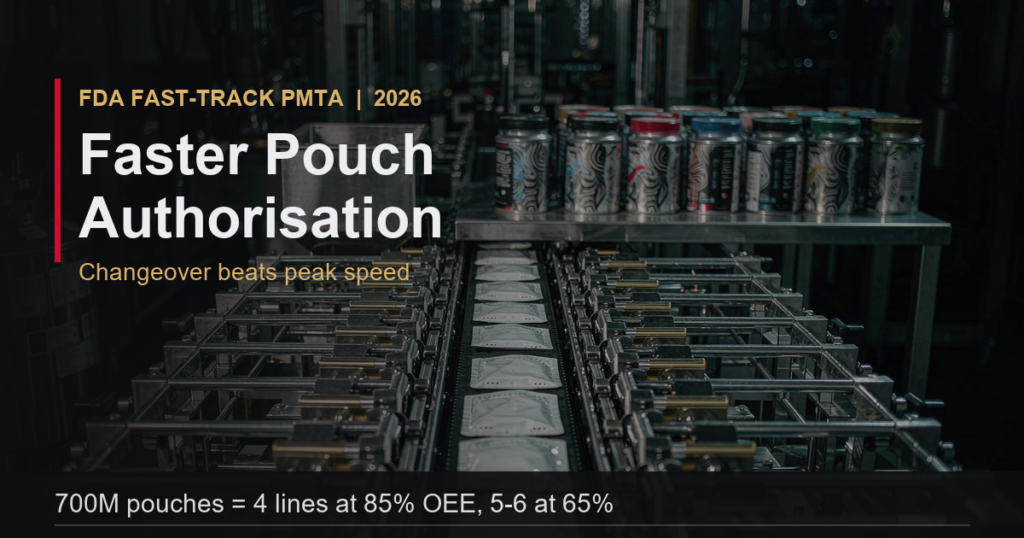
The US Food and Drug Administration is preparing to ease its 2021 premarket review framework for vapes and nicotine pouches, with measures expected within days, according to a Wall Street Journal report carried by Reuters on 23 September 2026. For pouch producers the headline is regulatory, but the consequence lands on the factory floor: a shorter authorisation cycle turns product variety from a two-year bet into a quarterly decision, and a packaging line specified for one format at maximum speed becomes the constraint rather than the asset.
This is what was reported, why it happened now, and the four equipment capabilities that matter most if authorisation timelines compress through 2027.
What was actually announced?
The reported facts, as of 23 September 2026:
- The FDA is expected in coming days to announce measures revising the 2021 rule that set premarket tobacco product application (PMTA) requirements.
- Changes under discussion include simplified scientific evidence standards and shorter review timelines for non-combustible products, with nicotine pouches and flavoured vapes named specifically.
- A US Department of Health and Human Services spokesperson framed the direction as keeping nicotine away from minors, removing counterfeit vaping products from the market, and giving adults who want to quit cigarettes safer alternatives.
- Public health groups and some lawmakers pushed back immediately, arguing enforcement should come before any lowering of evidentiary standards.
Why now: the 180-day deadline nobody met
US law requires the FDA to reach a decision within 180 days of receiving a PMTA. In early September 2026 Altria sued the agency in federal court, arguing it has never met that deadline and that some applications have been pending for years. Altria named its on! nicotine pouch products directly and pointed out that unauthorised imported competitors were gaining share while its own application sat in the queue. Independent vape manufacturers have filed comparable actions.
The agency had already signalled the shift. In late August 2026 it authorised three JUUL2 products, including two flavoured variants. A faster pathway is a formalisation of a direction already visible in individual decisions, not a sudden reversal.
How faster authorisation changes what you need from a machine
A two-to-four-year authorisation cycle rewards a line built for one format at maximum throughput. A six-to-twelve-month cycle rewards a line that can be reconfigured quickly and documented quickly. The difference shows up in four places.
| Decision | Assumption under a 3-4 year cycle | What a compressed cycle demands |
|---|---|---|
| Line specification | Peak pouches per minute on one pouch size | Full fill-weight range without a tooling swap |
| Changeover | Weekly or monthly | Same-day, sometimes twice a day |
| Documentation | Commissioning report at handover | IQ/OQ/PQ package tied to the submitted product |
| Capacity plan | One large line sized for a five-year forecast | Modular lanes added as SKUs clear authorisation |
1. Changeover becomes the bottleneck, not speed
On a 1,200 ppm line running two shifts at 85% OEE, output is 1,020 ppm, or 61,200 pouches per hour, or 979,200 pouches per 16-hour day. A single 60-minute flavour or strength changeover costs 61,200 pouches. That is 6.25% of the day. Move from one SKU per day to three SKUs per day and you add two changeovers, 12.5% of installed capacity, before a single mechanical fault is counted.
This is why a machine quoted at 1,200 ppm rarely delivers 1,200 ppm in a portfolio business. The number that predicts your real output is changeover minutes per week, and it is worth asking for it in writing.
2. Fill weight range beats peak speed
Portion sachets for oral pouches typically run 0.3-1.2 g across dry and moist formats. If a faster pathway lets you launch three strengths inside a year, a machine that holds ±1-2% at 0.5 g but needs a new auger and two hours of recalibration for 0.35 g is not a flexible asset. Ask vendors for the dosing accuracy figure at the top and bottom of your intended weight range, not at the single weight they used for the demo.
3. Documentation moves from nice-to-have to deliverable
A marketing granted order attaches to the product and process you submitted. When the cycle was four years, you had time to assemble equipment documentation retrospectively. When it is months, suppliers who ship IQ/OQ/PQ protocols, material certificates for product-contact parts, and calibration traceability as a standard package remove weeks from your filing. Make this a line item in the quotation, not an afterthought at commissioning.
4. Modular capacity beats one big bet
If authorisation arrives faster than you can forecast demand, the risk shifts from under-sizing to over-committing. A 4-lane block that can be extended, or a second identical line ordered six months later, keeps capital aligned with approved SKUs instead of hoped-for ones.
Capacity math: what 700 million pouches means in machines
British American Tobacco reported that pouch volumes across Asia, the Middle East and Africa rose 27.5% to around 700 million pouches in the first half of 2026. That is a useful calibration figure because it can be converted directly into equipment.
| Line rating | OEE | Effective ppm | Output per 181-day half, 2 shifts | Lines needed for 700M |
|---|---|---|---|---|
| 1,200 ppm | 85% | 1,020 | 177.2 million | 4.0 |
| 1,200 ppm | 65% | 780 | 135.5 million | 5.2 |
| 800 ppm | 85% | 680 | 118.1 million | 5.9 |
| 800 ppm | 65% | 520 | 90.3 million | 7.8 |
Read the 65% rows as the realistic case. OEE at 65% is what a multi-SKU plant actually achieves once flavour changeovers, format swaps, cleaning, start-up scrap and quality holds are counted. The same 700 million pouches that need four lines on a brochure need between five and six on a production plan. That gap, roughly one extra line per 700 million pouches, is where budgets break.
The 19-month benchmark: lead time is on the critical path
PMI opened its Aurora, Colorado campus with commercial production starting in July 2026. Planned investment for the site doubled from 600 million to 1.2 billion dollars across 2024-2028, with roughly 1 billion already spent. The 780,000 square foot facility on a 148-acre site went from groundbreaking to commercial shipments in approximately 19 months, and integrates production, packaging, warehousing and distribution in one location. It is expected to employ around 500 people directly.
Nineteen months is a greenfield benchmark built by a company with an unconstrained budget. For a mid-size brand converting an existing building, the building is not the critical path any more. The equipment is. If your fit-out takes five months and your machine takes seven, a fast authorisation does not help you, because the line arrives after the demand window it was meant to serve.
Four questions to ask before signing a purchase order
- What is the validated changeover time between my two most different formats, measured on a built machine, not estimated?
- What is the dosing tolerance at the lightest and heaviest fill weight I intend to run, not just at the demo weight?
- Which documentation ships with the machine, and how many weeks after delivery does the full validation package arrive?
- Can I add lanes later without replacing the frame, and what does the second block cost if ordered in year two?
Risks worth watching
- The pathway is not final. The FDA announcement was still pending at time of writing and details may change. Plan flexibility, do not build a single-format line on the assumption of a specific rule text.
- Faster authorisation cuts both ways. Your competitors get through the queue faster too. Differentiation moves further towards flavour, strength and pack format, all of which are changeover variables.
- State-level rules do not move with federal ones. US federal authorisation does not override state flavour bans, and the EU Tobacco Products Directive revision is a separate track entirely.
Next step
If you are specifying a nicotine pouch packaging machine against a 2027 launch, the decision that will cost you the most is not speed. It is how many formats the line can absorb without a tooling change, and how fast the documentation reaches your regulatory team.
Our engineering team builds sachet and stick pack machinery for exactly this kind of multi-SKU environment, and we also run OEM pouch manufacturing for brands that want to validate a format on a production line before committing to equipment. Send us your target fill weights, format list and expected SKU count per year and we will come back with a changeover estimate and a lane count. Contact our engineering team to start, or read more about PouchMfg and how we build lines.