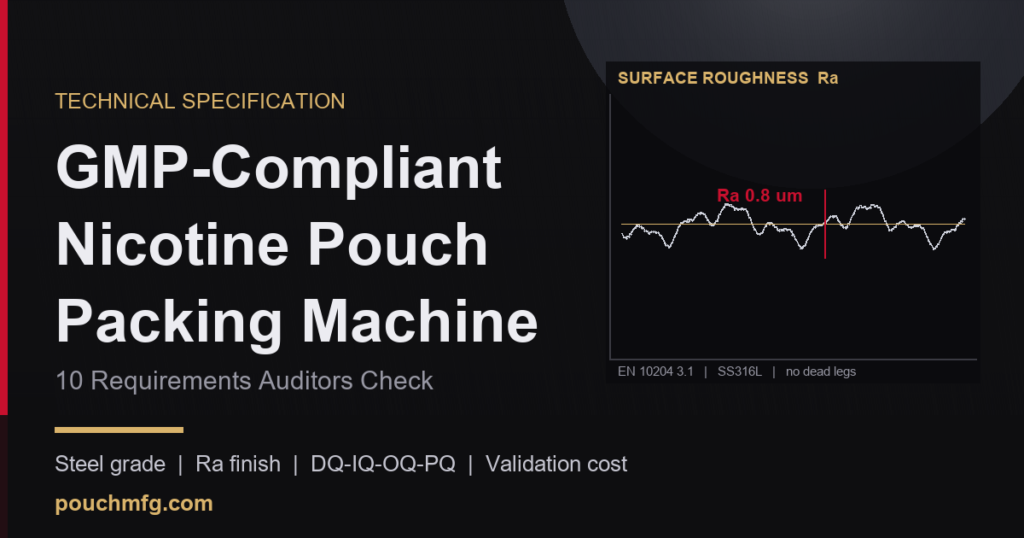
A GMP-compliant nicotine pouch packing machine is one whose product-contact materials, cleanable geometry, dosing control and documentation package can survive a third-party audit. In specification terms that means SS316L or SS304 contact parts with a measured surface finish of Ra 0.8 micrometres or better, no dead legs or threaded product connections, a recipe-driven PLC with role-based access, and a DQ/IQ/OQ/PQ document set with traceable calibration certificates. Machines that meet this bar cost roughly 8 to 15 percent more than a cosmetic-only build, and the difference shows up almost entirely in paperwork and weld finishing rather than in speed.
That last point matters because most buyers shop on speed alone. A 10-lane line rated at 800 pouches per minute is worthless to a brand supplying pharmacy chains if the machine cannot produce a mill certificate for the steel or a weld log for the product path. This guide sets out the ten requirements that actually get checked, with the numbers to write into your user requirement specification (URS) before you request a quote.
What does GMP compliance mean for a nicotine pouch packing machine?
GMP compliance for this equipment means the machine can be shown, on paper and in metal, to consistently produce pouches that meet their specification without contaminating the blend. It is not a certificate a supplier hangs on a wall. It is a set of design decisions plus a document trail that lets an auditor reconstruct how any given pouch was made.
For nicotine pouches the applicable frame depends on your market. Products positioned as tobacco or consumer goods generally follow food-contact hygiene rules plus internal quality systems. Products positioned as a nicotine replacement therapy or sold into pharmacy channels fall under 21 CFR Parts 210 and 211 in the United States, EudraLex Volume 4 in the European Union, and WHO GMP TRS 961 Annex 6 in many emerging markets. The WHO annex is the most explicit about machinery and is the one most manufacturers build to by default.
Which parts of the machine count as product-contact surfaces?
Everything the blend touches between the hopper and the sealed pouch, plus anything that can shed particles into that path. Auditors will walk this path with you, so define it in the URS before the machine is built rather than arguing about it afterwards.
- Hopper and hopper lid including the sight glass gasket and the level sensor boss.
- Dosing tooling: auger, auger barrel, volumetric cups, scraper blades and the funnel below the filler.
- Product chute and transfer tubes between the filler and the forming tube.
- Forming tube and forming collar on a vertical form-fill-seal section.
- Sealing jaw faces, since they contact pouch material millimetres from the product and can deposit residue.
- Coding and rejection hardware positioned above an open pouch.
Non-contact items such as the machine frame, guarding, electrical cabinet and conveyor side rails are not product contact, but a washdown environment still pushes them to SS304 and IP65 rather than painted carbon steel.
What steel grade and surface finish should you specify?
Specify the grade and the finish separately, and require a mill certificate for each. A supplier quoting “stainless steel” without a grade is quoting 201 or 430, both of which will rust in a nicotine blending room within a year.
| Zone | Material | Surface finish | Certification to request |
|---|---|---|---|
| Product contact (hopper, auger, chute, tube) | SS316L, carbon 0.03% max, molybdenum 2.0 to 2.5% | Ra 0.8 micrometres or better; Ra 0.4 micrometres mirror polish for pharma filings | EN 10204 type 3.1 mill certificate |
| Splash or indirect zone (jaw bodies, guard interiors) | SS304 | Ra 0.8 to 1.6 micrometres, satin | Material declaration |
| Non-contact frame and cabinet | SS304 or powder-coated carbon steel | Not specified | Not required |
| Elastomers and gaskets | EPDM, silicone or PTFE | Not applicable | Food-contact declaration per FDA 21 CFR 177 or EU 1935/2004 |
The Ra figure is measured, not claimed. Ask for the actual roughness test report with the probe location marked, because a machined surface that looks bright under workshop lighting routinely measures Ra 1.6 to 3.2 micrometres, which is double the WHO limit and will hold blend residue and bacteria.
How do you design dead legs and cleaning problems out?
Four design rules cover almost every non-conformance found in the field:
- Sanitary connections only. Tri-clamp or equivalent on any product-path joint that is opened for cleaning. Threaded connections in the product path are the single most cited finding because the thread root cannot be cleaned or inspected.
- No horizontal ledges or blind pockets. Brackets, sensor bosses and cable trays above the product path must be sloped or sealed so blend cannot settle and later fall into an open pouch.
- Tool-free strip-down of the dosing group. An operator should be able to remove the auger, barrel and funnel without tools in under 15 minutes. If strip-down needs a spanner and 45 minutes, cleaning will be skipped on the night shift.
- IP65 minimum on everything in the wash zone. Wet cleaning is normal for moist snus and for any line running 30 to 45 percent moisture blend. IP54 cabinets fail within two years in that environment.
Ask the supplier for a cleaning validation protocol and a stated strip-down time. Both are cheap to design in and effectively impossible to retrofit.
What dosing accuracy will an auditor accept?
For a 0.5 gram pouch, the industry norm is plus or minus 1 percent on a servo auger filler, and plus or minus 1 to 2 percent on a volumetric cup filler running a free-flowing blend. Laboratory and bench machines are quoted at plus or minus 10 percent and should never appear in a production specification.
The auditor is less interested in the number than in the evidence. Expect to show:
- Gravimetric checkweigher data or a documented 30-pouch weight study per shift at start-up, mid-run and end-of-run.
- Calibration certificates for the checkweigher, thermocouples and speed encoder, dated within 12 months and traceable to NIST, NPL or PTB.
- A defined rejection rule and a recorded reject count, so an out-of-spec pouch can be proven to have left the line rather than the batch.
- Statistical process control limits with an action threshold, typically set at two-thirds of the specification limit.
The commercial reason to care is not the audit. Moving average overfill from plus 3 percent to plus 1 percent on a 4-lane line running 0.5 gram pouches at 300 pouches per minute per lane saves roughly 48 kilograms of blend a year, which at USD 60 per kilogram is about USD 2,900 annually per machine.
What must the documentation package contain?
| Document | What it proves | Who issues it | When |
|---|---|---|---|
| URS (user requirement specification) | What you asked for, in measurable terms | Buyer | Before order |
| DQ (design qualification) | The offered design meets each URS line | Supplier, buyer signs | Before build |
| FAT protocol and report | The machine runs to spec at the factory | Supplier | Before shipment |
| IQ (installation qualification) | Installed correctly, utilities correct, materials as specified | Supplier plus buyer | On site, week 1 |
| OQ (operational qualification) | Runs safely across the full parameter range | Supplier plus buyer | On site, weeks 1 to 2 |
| PQ (performance qualification) | Produces conforming pouches over three consecutive production runs | Buyer | On site, weeks 2 to 4 |
| Traceability matrix | Every URS line maps to a test and a result | Supplier | With DQ |
| Weld log and material certificates | The product path is the grade you paid for | Supplier | With shipment |
Records must be retained for at least five years after the equipment is decommissioned under the WHO annex, so specify the format and language at order stage. English and the local language of the operating site is the usual requirement.
Does the control software need 21 CFR Part 11 features?
If you sell into the United States as a regulated nicotine product, yes. If you sell as a consumer or tobacco product, they are optional but cheap insurance. The four features that matter are an audit trail recording who changed which parameter and when, electronic signatures on batch release, role-based access so an operator cannot alter a recipe, and protected recipe storage with version history.
On multi-lane equipment these features also have a plain operational payoff. Recipe-driven changeover on a 4 to 10 lane line cuts format change from 3 to 4 hours on a first run to 60 to 90 minutes once the recipe is stored and proven, which on a two-SKU plant is worth several shifts a year.
How much does GMP validation cost and how long does it take?
| Scope | Typical cost | Typical duration | Suits |
|---|---|---|---|
| Full pharma scope, DQ through PQ with FMEA and software validation | USD 35,000 to 140,000 | 7 to 14 weeks | NRT filings, EU pharmacy channel |
| Risk-based scope, DQ plus IQ plus OQ plus abbreviated PQ | USD 6,000 to 18,000 | 2 to 4 weeks | Consumer nicotine pouches, private label |
| Documentation only, no on-site execution | USD 1,500 to 4,000 | 1 to 2 weeks | Startups buying a first machine |
The full pharma figures are real and should be in your total cost of ownership model before you commit. Most nicotine pouch brands fall into the middle row. Insist the supplier provides the protocols as standard deliverables rather than priced extras, and that they assist with execution rather than emailing blank templates.
What are the GMP failures buyers find too late?
- 201 or 430 stainless sold as 304 or 316L. Demand the EN 10204 3.1 certificate with the heat number, and consider a third-party positive material identification test on the hopper before shipment. This is the most common and the most expensive finding, because remediation usually means replacing the whole product path.
- Ra claimed but never measured. A polished-looking surface at Ra 3.2 micrometres fails. Ask for the test report.
- No weld log. Every product-path weld should be ground flush, polished to the contact standard and logged with the welder identification.
- Calibration certificates missing or expired. Thermocouples and checkweighers without current certificates invalidate your PQ data retroactively.
- Software with no audit trail. Retrofitting Part 11 features to a PLC platform that does not support them means replacing the control system.
- Spare parts with no traceability. A non-certified replacement auger quietly breaks your material compliance. Specify that wear-part spares ship with the same certification as the originals.
Where to go from here
Write the URS before you compare quotes. Ten measurable lines covering material grade, surface finish, dosing accuracy, strip-down time, ingress rating and the document deliverables will separate suppliers who can support an audit from those who can only sell you a speed figure.
If you are specifying a nicotine pouch packaging machine for a regulated market, or comparing sachet and stick pack machinery against a GMP requirement, send us the URS and we will mark it up against what we can actually build and certify. If you would rather not buy equipment yet, OEM pouch manufacturing lets you launch under an already-qualified process. To review a specification or book a factory acceptance test, contact our engineering team, and you can read more about PouchMfg and how we build.