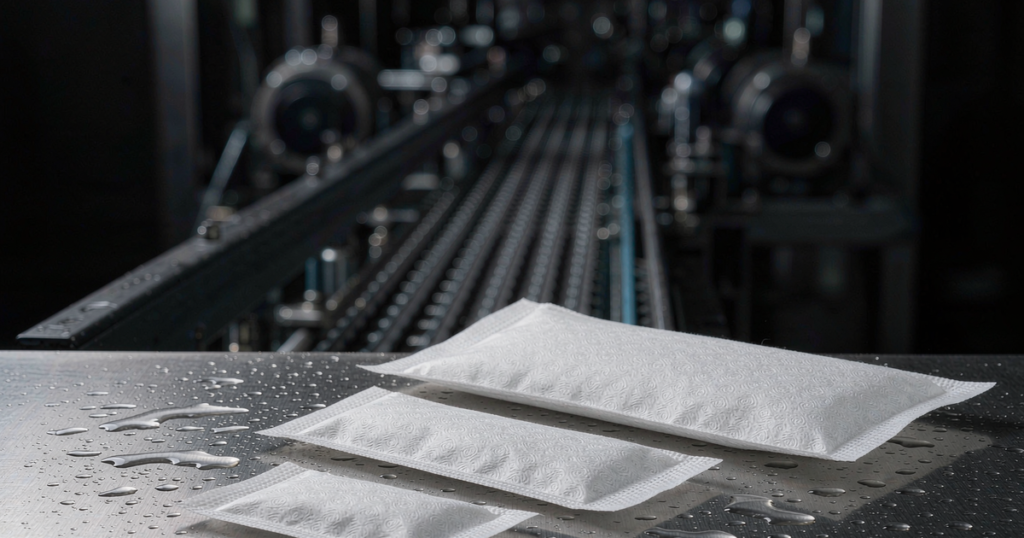
Mini, slim and large are pouch formats, not machine settings — but each one changes the fill weight, the dosing tolerance, the seal geometry and the line speed of a nicotine pouch packaging machine. A 0.4–0.5 g mini pouch can run at 330–350 pouches per minute on a single lane, while a 1.0 g large pouch drops the same lane to 180–220 ppm because the filler needs longer to dose. Switching format is therefore a changeover event with a recipe, a forming set and a tolerance re-validation, not a button press.
Also called a pouch filling machine, a pouch making machine or an oral pouch machine — and a portion packing machine in Sweden — a nicotine pouch packaging machine forms, doses and seals non-woven pouches at 200–1,200 pouches per minute across 4 to 12 lanes. Buyers typing Zyn pouch machine, snus machine or white snus line into a search box are usually looking at the same hardware; the first question any engineer should ask back is which format you intend to run, and at what gram target.
What does pouch format actually change on a nicotine pouch machine?
Four things: target fill weight, the dosing technology that can hold it, the geometry of the forming and sealing station, and achievable throughput. Everything downstream shifts with them — cans per day, non-woven consumption in kg, and the strength a label claims to a regulator such as the FDA under a PMTA. ZYN, VELO and on! run different formats on one platform, and contract packers serving Swedish Match, BAT or PMI private-label programmes switch format between shifts. That flexibility is a machine specification, so it has to appear in the RFQ as numbers, not as a claim.
What are the real fill weights for mini, slim and large pouches?
Format names are not legally standardised. A VELO Mini and a ZYN Mini are close but not identical, so an RFQ saying only “slim” without a gram target and a millimetre dimension will be quoted differently by every supplier. These are the ranges the industry has converged on:
| Format | Typical fill weight | Approximate dimensions | Pouches per can | Common strengths (mg per pouch) |
|---|---|---|---|---|
| Mini | 0.3–0.5 g (ZYN Mini ~0.4 g) | 13 × 28 mm to 30 × 8 mm | 20 (US: can / UK: tin) | 1.5 / 3 / 6 mg |
| Slim | 0.6–0.75 g (ZYN Regular ~0.8 g) | 14 × 34 mm to 34 × 10 mm | 15–21 | 4 / 6 / 9 up to 16.5 mg |
| Regular / Large | 0.8–1.1 g | 30–35 × 13–16 mm | 20–25 | 6–20 mg |
| Maxi (Scandinavia) | 1.2–1.7 g | up to 40 × 15–18 mm | 20 | up to 43 mg |
Note the vocabulary: a US buyer asks for a can, a UK buyer for a tin. A slim tin usually holds 15–20 pouches and a round can 20–25, and that ratio is what converts pouches per minute into cans per minute on your line.
How does pouch weight change mg per pouch, and why does it matter for dosing?
Strength is stated two ways and the machine is responsible for both: mg per pouch = mg per gram × pouch weight in grams. At a 43 mg/g formulation, a 0.45 g mini carries about 19.4 mg, a 0.65 g slim about 28 mg and a 1.0 g pouch about 43 mg. Halve the fill weight and you halve the label claim without touching the blend. That makes dosing accuracy a compliance parameter: if a label says 6 mg per pouch and the filler drifts ±10% on a 0.4 g mini, the certificate of analysis and batch traceability record will not reconcile. ZYN lists 1.5, 3 and 6 mg for Mini and up to 16.5 mg for Regular because the filler holds weight inside that window. Our guide to OEM pouch manufacturing covers how strength labelling feeds back into equipment.
How much does format affect line speed in pouches per minute?
Fill weight drives dosing time, and dosing time drives the cycle:
| Format | Fill weight | Typical single-lane output | Approx. output per 8-hour shift at 90% OEE |
|---|---|---|---|
| Mini | 0.5 g | 330–350 ppm | 143,000–151,000 pouches |
| Slim | 0.7 g | 270–300 ppm | 117,000–130,000 pouches |
| Regular | 0.8 g | 250–280 ppm | 108,000–121,000 pouches |
| Large | 1.0 g | 180–220 ppm | 78,000–95,000 pouches |
Multiply by lane count — 4, 6, 8, 10 or 12 lanes — and you reach the 200–1,200 ppm band quoted for multi-lane pouch machines. Divide by pouches per can to size the canning section, which typically runs 50–60 cans per minute: a 12-lane line at 1,200 ppm filling 20-count cans needs about 60 cans per minute downstream. If the can unscrambler and loader are bought for a lower rate, the whole line is throttled at the canning end.
What dosing accuracy does each format need?
| Dosing system | Typical accuracy | Best-fit format | Trade-off |
|---|---|---|---|
| Servo-driven micro-auger | ±1–2% (±0.2 g volumetric on some models) | Mini 0.4–0.5 g | Handles fine dry powder; needs bulk-density control |
| Multi-head weigher | ±0.5% | Slim to Large 0.65–1.0 g | Highest accuracy; cycle time is the bottleneck at low fill weights |
| Servo volumetric cup | ±1–2% | Slim 0.65–0.75 g | Simple and fast; sensitive to blend density shift |
A multi-head weigher at ±0.5% is not the right choice for a 0.4 g mini pouch: at that fill weight its cycle time becomes the constraint, and a servo-controlled micro-auger holds tolerance more consistently while running faster. The weigher earns its place on a slim or large pouch with an EU cap written as mg per gram, where the absolute gram error becomes a compliance margin.
What changes in the forming and sealing station?
Dedicated oral pouch machines usually cover a 12–28 mm wide by 30–40 mm long bag window with fill volumes around 0.4–0.8 g set from the HMI; general-purpose sachet and stick pack machinery spans a wider 20–70 mm by 30–100 mm envelope. Non-woven filter paper in the 30–37 gsm range is standard, sealed at 5–6 mm seal width. Ultrasonic sealing at 20 kHz with 18–35 µm amplitude bonds non-woven without burning the fibre or yellowing an all-white pouch, and suits dry nicotine and caffeine blends. Ultrasonic is not the right choice for heat-sealable laminate films — heat sealing at 130–160 °C for 0.5–1.0 s gives higher throughput there. Product-contact parts should be SS304 or 316L with GMP-grade clean-down access and CIP where the formulation is moist.
How long does a format changeover take, and what makes it fast?
Expect 15–20 minutes of setup time, and under 15 minutes of recipe changeover when format dimensions, dosing profile and sealing parameters are stored digitally. The features that produce that number:
- Recipe storage in the PLC + HMI — bag length, dose, seal temperature and cut position recalled as one record per SKU.
- Tool-less switchover — no wrenches on the forming tube or sealing jaws.
- Modular forming units — width and length swapped as a cassette, not re-machined.
- Servo-controlled motion — seal and cut positions set by parameter, not mechanical stop.
- Closed-loop weight feedback — checkweigher signal trims the filler so the first pouches after changeover are already in tolerance.
What should an RFQ specify so one line handles all three formats?
Put these in the enquiry and quotes become comparable instead of a page of adjectives:
- Format name plus gram target — “Slim, 0.7 g ±2%”, not “slim”.
- Pouch dimensions in millimetres, before and after filling.
- Pouches per can and can dimensions, so canning rate matches pouch rate.
- Required output in ppm per lane and total ppm at the quoted lane count.
- Dosing system and the accuracy signed for at each format, not one blanket number.
- Non-woven specification (gsm, composition, roll width) and sealing method with seal width.
- Changeover time measured format-to-format at FAT, plus utilities: 380 V three-phase, 0.6–0.8 MPa air at roughly 16 CFM (6 bar).
We can model a multi-format line against buying finished cans — contact our engineering team with the figures above, or read more about PouchMfg and how we validate lines.
When is a multi-format line not the right choice?
Two boundaries. If you run one format and one strength indefinitely, paying for tool-less changeover and a large recipe library is not justified — a fixed forming set is cheaper and holds tolerance better because nothing is re-adjusted. Second, the span between mini and maxi is wider than most machines serve well: a line optimised for 0.4 g is compromised at 1.7 g, so two narrower lines usually beat one covering both. Formulation matters as much as size — a dry pouch at around 3% moisture and a moist portion near 37% flow and dose differently, and moist products need refrigeration and a shorter shelf life that changes the downstream plan.
Frequently asked questions
Can one snus packing machine handle mini, slim and large pouches?
Yes, if the forming set, sealing jaws and dosing range cover the full span — most machines cover a 12–28 mm width window and 0.4–1.0 g dosing. Output differs by format: around 330–350 ppm on a mini versus 180–220 ppm on a large pouch on the same lane.
Does a smaller pouch mean less nicotine?
At the same mg per gram, yes, because mg per pouch equals mg per gram multiplied by pouch weight. But brands set strength independently of size, so read both numbers on the can — format is not a reliable proxy for strength.
Do I need a new PMTA to change pouch format in the US?
Changing pouch weight or dimensions alters the authorised product. The FDA treats the finished article, including fill weight, as the authorised product, so reassess the submission and supporting data rather than silently retooling. Confirm with regulatory counsel first.
What tolerance should I write into the supply contract?
Specify it per format and tie it to the label claim — for example ±2% on a 0.7 g slim, measured over a defined sample plan at FAT and SAT with checkweigher data as the acceptance record. One blanket accuracy figure across all formats is a common cause of commissioning disputes.
Whether you run a single slim SKU or a mini-to-large catalogue, the specification starts with gram target, dimensions and pouches per can. Send those three numbers to our engineering team and you will get a configuration, a changeover time and an FAT acceptance sheet you can hold us to.