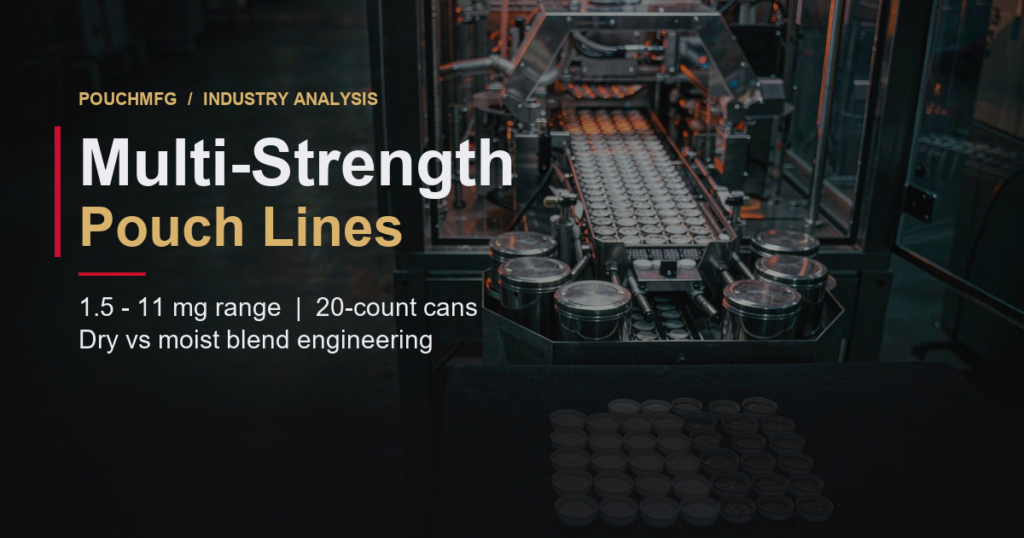
On September 15, 2026, PMI U.S. confirmed three ZYN portfolio changes that will reach packaging floors before they reach retail shelves: new 1.5 mg and 8 mg dry-pouch strengths, a move from 15 to 20 pouches per can on core 3 mg and 6 mg variants during Q4, and the moist-format ZYN ULTRA line that FDA authorized in August. For equipment buyers the story is not demand growth. It is a strength range that now spans 1.5 mg to 11 mg at near-constant fill weight, a 33% increase in pouches per can, and a second material that behaves nothing like the dry blend most lines were originally specified for.
Here is what each change does to a nicotine pouch packaging machine specification, and what to check before you quote a multi-strength run.
What exactly changed on September 15, 2026?
Three separate announcements landed in the same release, and each one moves a different part of the packaging line.
| Change | Detail | Packaging consequence |
|---|---|---|
| New dry-pouch strengths | 1.5 mg and 8 mg added to a line that was 3 mg and 6 mg only | Wider mg-per-gram spread; dosing recipe and blend validation must cover the full range |
| 20 pouches per can | 3 mg and 6 mg variants move from 15 to 20 per can in Q4 2026 | Counting channel, can stack height and upstream output all need +33% |
| Moist ULTRA format | 11 products authorized Aug 21, 2026 (ten at 9 mg, one at 11 mg) | Cohesive blend, moisture at the seal jaw, higher-barrier film, stricter cleaning |
| New capacity | Aurora, Colorado plant (780,000 sq ft) began commercial production July 2026 | Tier-one capacity rises; contract packers compete on flexibility, not volume |
Why does a 1.5 mg to 11 mg range break single-recipe dosing?
Because the pouch weight barely moves while the nicotine load changes by a factor of seven. A US mini-format pouch holds roughly 0.4–0.5 g. That means the blend itself, not the filler, now carries the compliance burden.
| Labeled strength | mg per gram (0.4 g fill) | mg per gram (0.5 g fill) | Practical risk |
|---|---|---|---|
| 1.5 mg | 3.75 mg/g | 3.00 mg/g | Diluent-dominated flow; fines segregation |
| 3 mg | 7.50 mg/g | 6.00 mg/g | Baseline for most existing recipes |
| 8 mg | 20.00 mg/g | 16.00 mg/g | Higher-value blend; giveaway is expensive |
| 11 mg (ULTRA) | 27.50 mg/g | 22.00 mg/g | Moist matrix; assay uniformity dominates |
Run the tolerance arithmetic and the conclusion is uncomfortable for anyone selling on filler accuracy alone. A servo auger holding ±1–2% of fill weight on a 0.4 g pouch varies the dose by about ±0.008 g. On a 1.5 mg product that is roughly ±0.03 mg of nicotine — well inside a typical ±10% label assay window of 1.35–1.65 mg. The filler is not the binding constraint. Blend homogeneity is.
If nicotine is not uniformly distributed through the microcrystalline cellulose carrier, a perfectly weighed pouch still fails assay. That is why multi-strength programs need blend validation with a measured relative standard deviation across the batch, plus a sampling plan tied to assay rather than to weight. When you specify a sachet and stick pack machinery line for this work, ask for dosing repeatability data on your actual blend, not on salt or sugar.
What does 20 pouches per can do to line balance?
It removes a quarter of your can output unless you add pouch capacity. The arithmetic is simple and it catches buyers out.
- A 4-lane line running 800 pouches per minute at 15 per can produces 53.3 cans per minute.
- At 20 per can, the same 800 pouches per minute produces 40.0 cans per minute.
- To hold 53.3 cans per minute you now need 1,067 pouches per minute — a 33% increase in upstream output.
- Alternatively accept 40 cans per minute and re-plan your shift against can count, not pouch count.
Then check the physical side, which is where most retrofits fail. Counting modules on can lines typically use a light-curtain or vibratory channel set for a target count in the 10–20 range, and a rotary box packer running a round can of roughly 70 mm outside diameter and 20 mm height at about 18 cans per minute. Adding five more pouches changes settled stack height, so the existing can may not close without compression, and the leveling station may need a second press stroke. Verify stack height with real pouches before committing to a can specification.
Can one machine run both dry and moist pouch blends?
It can, but not on the same tooling configuration and not without a validated cleaning procedure between runs. Dry and moist formulations sit at opposite ends of the moisture scale and every downstream setting follows from that.
| Parameter | Dry pouch | Moist pouch |
|---|---|---|
| Moisture content | About 3–5% | About 30–40% |
| Flow behaviour | Free-flowing powder, dust-prone | Cohesive, bridges in hopper, needs agitation |
| Sealing | Standard heat seal, wide temperature window | Moisture flashes at the jaw; needs lower temperature with longer dwell, or ultrasonic |
| Film | Nonwoven 30–60 gsm | Higher-barrier laminate to limit moisture loss |
| Cleaning | Dry wipe-down between batches | Full strip-down; residual moisture is a microbial risk |
| Contact parts | SS304 usually sufficient | SS316 recommended for wetted parts |
| Shelf life | Up to about 12 months | Short; depends on water activity and pH control |
Suppliers who build for both format families usually handle this as a module swap rather than a recipe change: different feeding and discharge hardware for the two moisture levels, with a documented changeover and cleaning step in between. Budget for that when you compare quotes. A machine quoted for dry blend only is not a moist-pouch machine with a software update.
What should you verify before quoting a multi-strength run?
Six checks, in the order they tend to break.
- Blend uniformity data. Request the relative standard deviation of nicotine assay across a production batch. Weight accuracy means nothing if the blend segregates.
- Dosing repeatability on your material. Insist on a witnessed test with your own blend at the lowest and highest strength you intend to run, not at a mid-range target.
- Moisture specification in writing. If the customer says moist, get a number. 30% and 47% water content are different engineering problems.
- Can stack height with real pouches. Confirm 20 pouches settle and the lid seats without crushing, using production samples rather than CAD.
- Changeover frequency assumption. More SKUs at smaller batch sizes means changeover time dominates OEE. Tool-free adjustment and recipe memory matter more than peak speed.
- Cleaning validation between strengths. Cross-contamination from an 11 mg batch into a 1.5 mg batch is a compliance failure, not a quality note.
What does this mean for contract packers and startup brands?
The direction of travel is more SKUs, smaller batches and faster format turnover. A tier-one operator adding 780,000 square feet of capacity is not competing with a contract packer on volume; it is competing on consistency. The gap a smaller operator can exploit is responsiveness — running four strengths across two formats in a single shift.
That is an equipment question before it is a commercial one. A line configured for one blend and one count will spend more of its day being cleaned and re-tooled than producing. If you are planning capacity against this kind of product spread, contact our engineering team with your strength range, target count per can and moisture specification, and ask for a configuration that covers the full spread rather than a single recipe.
Where to go from here
Start by writing down the widest strength range and the highest pouch count per can you expect to run in the next 24 months, then size the line against those two numbers rather than today’s order book. Most under-specified lines are not too slow; they are too narrow.
If you need the material side handled rather than built in-house, our OEM pouch manufacturing programme covers dry and moist formats with documented blend and assay records. You can read more about PouchMfg and how we specify lines for multi-SKU production. For buyers already running several strengths, our step-by-step changeover procedure for flavour and format swaps is worth reviewing alongside this.