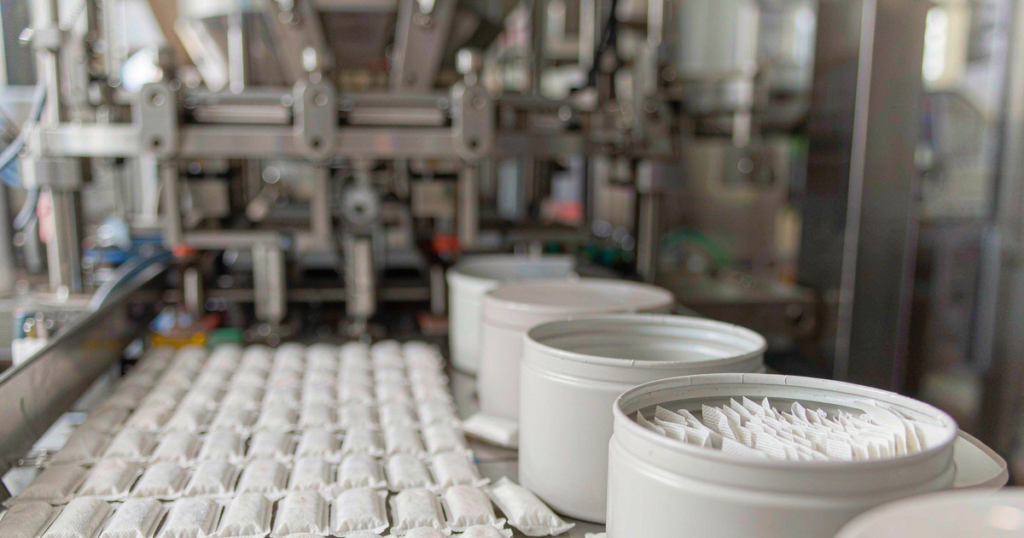
A nicotine pouch packaging machine is a multi-lane form-fill-seal system that doses 0.4–0.75 g of nicotine-cellulose blend into non-woven pouches at 200–1,200 pouches per minute, with dosing accuracy of ±0.5–2%. Also called a pouch filling machine, a pouch making machine or an oral pouch machine — and in Nordic buying circles a snus machine or portion packing machine — the invoice is only the first line of the budget. On a mid-size 6-lane line running one shift, plan on USD 140,000–340,000 of non-material running cost in year one, or roughly USD 0.07–0.17 per 20-count can at two million cans a year.
This article breaks that number down line by line, and gives you the two formulas buyers actually re-use: the non-woven consumption formula and the own-a-line-versus-buy-cans break-even. If you are comparing a nicotine pouch packaging machine against a white-label supply contract, start with the break-even table — it settles most of the argument.
What does it actually cost to run a nicotine pouch machine for a year?
The table below is a planning budget for a 6-lane pouch line plus can unscrambler, pouch-to-can loader and capper, running one shift at roughly 400 pouches per minute, 250 working days, about 1,625 productive hours and close to two million 20-count cans per year. Material and packaging (blend, can, lid, label) are excluded here and handled separately below.
| Cost line | Planning range (USD / year) | What drives the number |
|---|---|---|
| Preventive maintenance labour + one service visit | 3,000 – 8,000 | Quarterly in-house work plus an annual manufacturer service call |
| Wear parts and spares consumption | 5,000 – 15,000 | 1–3% of machine capital value per year is the common planning proxy |
| Critical spares kit (one-off, year 1) | 8,000 – 25,000 | Every part with a lead time longer than two weeks |
| Non-woven pouch paper, 30–37 GSM | 45,000 – 90,000 | 0.03–0.05 g per slim pouch at USD 30–35 per kg |
| Ultrasonic and sealing consumables | 2,000 – 6,000 | Horn re-facing, anvils, back-up tape, jaw covers |
| Utilities: power and compressed air | 6,000 – 18,000 | 8–18 kW installed plus 300–600 L/min at 0.6 MPa |
| Incremental operators and QA | 60,000 – 140,000 | One operator, one material handler, half a QA head — heavily region dependent |
| Calibration, CoA testing, validation | 10,000 – 40,000 | HPLC nicotine assay per batch, checkweigher and metal-detector checks, GMP documentation |
| Total, excluding materials and packaging | 139,000 – 342,000 | About USD 0.07–0.17 per can at 2 million cans a year |
Two caveats on this range. First, published maintenance allowances for integrated packaging cells run USD 15,000–60,000 a year and for high-speed specialised lines USD 50,000–150,000 or more — the wide spread in our table reflects duty cycle, not disagreement. Second, labour is the item most buyers under-budget: on a two-shift operation the operator line doubles while the spares line does not.
How much should you budget for spare parts and wear parts?
Use 1–3% of machine capital value per year as the starting number for spares consumption, then override it with the parts list below. A USD 250,000 line at 2% is USD 5,000 a year — which is realistic only if the line runs clean, dry product on one shift with good compressed air.
| Part | Typical service life | Failure mode | Stock on day one? |
|---|---|---|---|
| Ultrasonic horn / sonotrode | 6–18 months | Face wear and detuning under abrasive fill | Yes — one spare plus re-facing service |
| Sealing jaw heaters and thermocouples | 6–12 months | Thermal cycling fatigue, product dust on contacts | Yes — one full set |
| Timing and drive belts | 6–12 months | Tension loss, dust loading | Yes — two of each size |
| Auger or micro-auger screw and funnel | 9–18 months | Abrasive cellulose wear shows up first as fill-weight drift | Yes — one set |
| Multi-head weigher load cells | 3–5 years | Overload event, moisture ingress during washdown | One spare |
| Vacuum cups and grippers (can handling) | 3–6 months | Compression set, dust film | Yes — ten-packs |
| Photo-eyes and fibre sensors | 12–24 months | Dust film on lens, cable flex at the carrier | Yes — two |
| Servo drive and encoder | 5–10 years | Thermal stress, connector and cable failure | One — long lead time, the classic line-stopper |
| PLC I/O module, HMI panel | 5–10 years | Rare, but unrecoverable without a spare | One I/O module |
The rule we give buyers is simple: stock anything with a lead time longer than two weeks, and do not stock anything you can get in 48 hours. Servo drives, encoders and ultrasonic generators are the three that stop a line; belts and sensors are the three that stop it briefly and often.
What does the non-woven pouch material cost per pouch?
Oral-pouch-grade non-woven is quoted by GSM and by the kilogram: 30 GSM standard grades and 37 GSM premium grades are commonly listed around USD 30 and USD 35 per kg respectively, with the higher GSM specified for drier blends. Work your own number with this formula:
kilograms per year = (pouches per year × grams of non-woven per pouch) ÷ 1,000
For a slim pouch the cut blank with seal margin lands around 0.035–0.04 g at 30–37 GSM. On a 39-million-pouch year that is roughly 1,400–1,600 kg, or USD 45,000–55,000 at USD 30–35 per kg. Per 20-count can, the pouch paper is only about USD 0.02–0.04 — small per can, but it is one of the few lines where a machine decision moves the number.
That is where trim scrap comes in. Legacy web handling with mechanical brakes runs 5–8% trim scrap; servo-synchronised tension control on a rigid frame keeps edge-trim and start-up waste near or below 1.5–4%. Moving from 8% to 2% on a 39-million-pouch year returns roughly 90 kg of paper, about USD 2,700–3,200 a year. Over a five-year machine life that is real money, and it is why tension control belongs on the specification sheet, not in the options list.
How much do cans, lids and labelling add per can?
This is the boundary most first-time buyers miss. Published 2026 contract-manufacturing figures put a finished white-label can — blend, pouching labour, can filling and packaging — at about EUR 1.00 per can, with labelling and printing adding EUR 0.03–0.10 per can depending on finish and volume. Regional quotes vary widely: China-based OEM programmes are typically quoted around USD 1.10–1.90 per can at 10,000–50,000 can MOQs, while EU private-label programmes run about USD 1.80–3.20 per can at 5,000–20,000 can MOQs. Nordic white-label programmes set the MOQ per SKU at 10,080 cans, which is exactly why small brands start as buyers rather than manufacturers.
Note the language, because it changes what you are buying. White label means the manufacturer’s existing formula with your name on it. Private label means a formula developed for you, usually exclusive. Contract manufacturing or co-packing means you own the formula and rent the line. Only the third one requires you to know the blend specification — and only the third one gives you something a competitor cannot reorder.
When does owning the line beat buying cans?
Put the two sides on the same table. Own-make cost per can is the ownership cost from the first table divided by annual volume, plus material and packaging. A reasonable planning range for material and packaging on a 20-count can — nicotine blend, can, lid, label, carton — is USD 0.45–0.75 depending on strength and can specification.
| Annual volume | Ownership cost per can | Material + packaging per can | Total own-make | Typical contract price | Verdict |
|---|---|---|---|---|---|
| 250,000 cans | 0.56 – 1.37 | 0.45 – 0.75 | 1.01 – 2.12 | 1.10 – 3.20 | Marginal — capital risk is not yet paid for |
| 2,000,000 cans | 0.07 – 0.17 | 0.45 – 0.75 | 0.52 – 0.92 | 1.10 – 3.20 | Clear case for owning the line |
| 5,000,000 cans | 0.03 – 0.07 | 0.42 – 0.70 | 0.45 – 0.77 | 1.10 – 3.20 | Own it, and negotiate materials on annual contracts |
Here is the boundary sentence worth quoting: a multi-lane pouch line is not the right answer below roughly 150,000–250,000 cans a year. Below that volume the capital is usually better spent on inventory, market access and the regulatory file — the PMTA or EU notification work that actually decides whether the cans can be sold. And a second boundary, on the technical side: ultrasonic sealing is not the right choice for heat-sealable laminate films, where heat sealing gives higher throughput — ultrasonic earns its place on non-woven because it seals without burning the fibre.
What should be in the first-year budget that quotes leave out?
- Format tooling for the second SKU. Mini 0.4–0.5 g, Slim 0.65–0.75 g and Large around 1.0 g are different forming sets and different dosing recipes. Budget the second set at quotation time, not after the first production run.
- A critical spares kit written into the contract. Negotiate it as a package with the machine, not as a later purchase order.
- Operator training at FAT, not after SAT. Training delivered at the factory acceptance test costs travel; training delivered after delivery costs production.
- Calibration and reference standards. Certified test weights, a calibrated checkweigher reference, and HPLC assay budget per batch.
- Compressed air quality. Dry, filtered air at 0.6 MPa. Wet air is the single cheapest way to shorten the life of every pneumatic part on the line.
How much does a nicotine pouch machine cost to run per hour?
Divide the annual running budget by productive hours. At 1,625 productive hours and USD 140,000–340,000 a year, the line costs USD 86–210 per productive hour before materials. That number is the one to use when you weigh a changeover decision: a format change that costs 45 minutes costs USD 65–160 in machine time alone, which is why tool-free changeover and recipe storage pay for themselves on lines running more than two SKUs.
What is the single biggest hidden cost?
Unplanned downtime on a part with a long lead time. A failed servo drive with a six-week lead time costs more than the entire annual spares budget of a well-stocked line. Everything else in this article is a rounding error next to that.
Next step
Build your own version of the first table with your volume, your labour rates and your pouch GSM, then sanity-check it against a contract-manufacturing quote before you commit capital. If you want the equipment-side numbers — spares kit contents, tooling sets for mini, slim and large formats, or the OEM pouch manufacturing route instead of owning a line — contact our engineering team with your target annual volume and pouch format. You can also read more about PouchMfg and how we specify multi-lane pouch production lines for FDA-registered and GMP facilities.