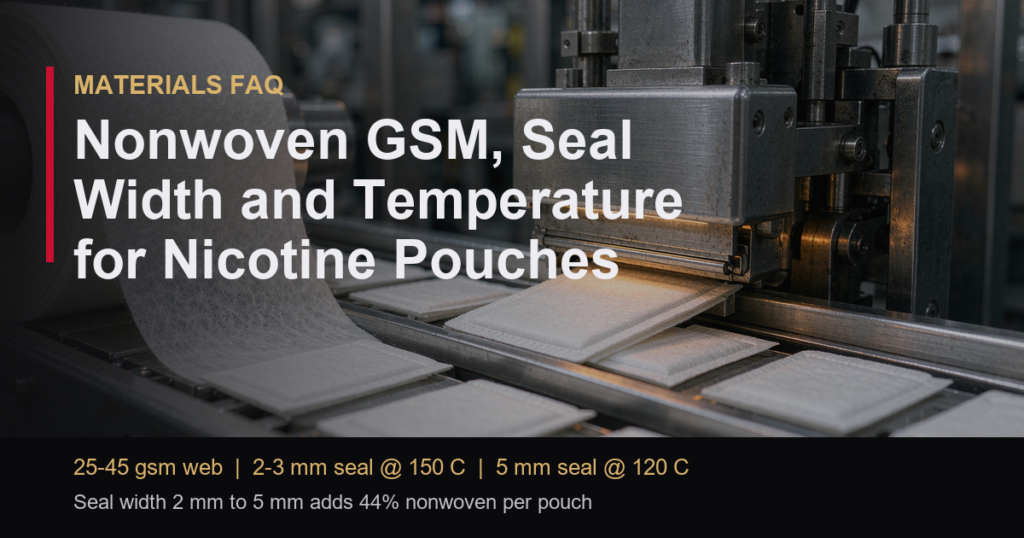
A nicotine pouch is closed by sealing, not by adhesive, and almost every pouch on the market is made from a food-grade nonwoven of 25–45 g/m² (35–37 g/m² bico-spunbond PE/PET is the industry default), sealed at a width of 2–5 mm with a jaw temperature of 110–160 °C. Those three numbers decide whether the pouch leaks powder into the can or feels like a hard plastic ridge under the lip — and they also decide how much web you buy per year. Below are the eight questions buyers ask before locking a web, a seal recipe, or a nicotine pouch packaging machine.
Which nonwoven fabric does a nicotine pouch use, and what GSM?
Commercial pouch webs are blends of cellulose pulp or viscose with a thermoplastic binder fibre. The construction cited most often in pouch patents is roughly 60 wt% soft pulp to 40 wt% PP/PE bicomponent fibre, wet-laid or spunbonded, which gives a web that is soft in the mouth, permeable to saliva, and still heat-sealable.
Compostable variants swap the polyolefin binder for PLA/PET or PBS/PET. They seal, but the window is narrower and the web is less forgiving of a hot jaw — which is the single most common reason a compostable trial fails on a machine that was set up for PE/PET.
| Parameter | Typical value | Why it matters to the machine |
|---|---|---|
| Basis weight | 25–45 g/m² (35–37 g/m² most common) | Sets web tension, seal energy and per-pouch material cost |
| Fibre composition | 55–65% pulp or viscose + 35–45% PP/PE | Binder content below ~30% gives weak seals |
| Thickness | ~95 µm at 26.5 g/m² | Drives folding shoe and former geometry |
| Dry tensile | ~1.28 N/mm, elongation ~83% | Low elongation webs snap on intermittent pull belts |
| Slit width | 35–45 mm per lane (master roll 25–800 mm) | Lane count is capped by web width, not by machine frame |
| Roll length | 700–900 m, 76 mm core ID | Sets splice frequency and therefore OEE |
| Continuous thermal limit | ~135 °C | Above this the web yellows and hardens |
| Food-contact status | FDA, EU 1935/2004, GB 4806.7; NSF / GMP / HACCP / SQF on request | Required for most retail listings and for OEM pouch manufacturing contracts |
What seal width should a nicotine pouch use?
Use 2–3 mm for slim formats and 5 mm only where you need strength at a lower temperature. The seal is the stiffest part of the pouch, so every extra millimetre is felt in the mouth, and it is also wasted fabric.
Take a 20 × 35 mm pouch body. With 2 mm seals on all sides the web consumed is 24 × 39 mm = 936 mm². With 5 mm seals it is 30 × 45 mm = 1,350 mm² — 44% more nonwoven for the same fill weight. On a four-lane line at 400 ppm running one 8-hour shift, 250 days a year (about 48 million pouches), that difference is roughly 0.7 tonnes of extra web annually, before you count the trim between lanes.
What sealing temperature should I run?
It depends on seal width, because seal area and temperature trade against each other. Published test data on a 26.5 g/m² pulp/PP-PE web measured dry seal strength at four temperatures and three widths:
| Seal width | 120 °C | 150 °C | 180 °C | 210 °C |
|---|---|---|---|---|
| 2 mm | 0.04 ± 0.02 N/mm | 0.27 ± 0.02 N/mm | 0.34 ± 0.03 N/mm | 0.39 ± 0.03 N/mm |
| 3 mm | 0.18 ± 0.02 N/mm | 0.22 ± 0.02 N/mm | 0.26 ± 0.03 N/mm | 0.33 ± 0.03 N/mm |
| 5 mm | 0.26 ± 0.02 N/mm | 0.26 ± 0.02 N/mm | 0.26 ± 0.03 N/mm | 0.35 ± 0.03 N/mm |
Two things fall out of that table. First, at 2 mm you need 150 °C before the seal is worth anything; at 5 mm, 120 °C already reaches the same strength. Second, at 180 °C and above the web surface hardens and discolours on every width — the seal gets stronger while the pouch gets worse. That is why most pouch lines settle in the 110–160 °C band with a 2–3 mm jaw.
Heat sealing or ultrasonic sealing — which one?
Heat sealing is cheaper, easier to validate, and forgiving of web variation; it is the right default for a single-SKU line. Ultrasonic sealing puts energy only at the interface, so there is no heat-affected zone and no surface hardening, and it will bond webs with too little thermoplastic content to heat-seal well — including several compostable PLA and PBS grades.
The costs are real: an ultrasonic stack per lane is a meaningful capex adder, horns wear and need replacement, and the process window is narrow enough that a drift in web basis weight shows up as seal failures rather than as a slightly soft seal. Choose ultrasonic when your web demands it or when you run compostable material at scale, not as a default.
How much moisture should the fill have, and does it change the web?
Yes, and this is where a lot of startups get burned. Dry US-style pouches run at or below about 4–5% moisture; European moist snus and moist pouches run 15–30%. Measured values on retail products span 3.5% to 37% moisture with water activity from 0.56 to 0.92:
| Product type | Moisture content | Water activity (aw) | Consequence for packaging |
|---|---|---|---|
| Dry pouch (US style) | 3.5–6.7% | 0.56–0.57 | Longest shelf life, standard thermal-bond web is fine |
| Semi-moist | ~14.7% | ~0.65 | Web needs wet strength; watch seal creep |
| Moist snus / moist pouch | 26.6–37.2% | 0.87–0.92 | Spunlace or chemically bonded web, barrier secondary pack, shorter shelf life |
Above roughly aw 0.6, water migrates into the web and then out through the can closure. The web must hold its strength wet, the seal must resist creep under a humid load, and the secondary pack has to do barrier work. If you plan to run both dry and moist formats on one sachet and stick pack machinery platform, say so at the enquiry stage — the web path, sealing tooling and cleaning access are different.
How long is the shelf life, and what degrades first?
Sealed and stored cool, 12–24 months: dry formats push toward 24 months, moist formats around 12, oil-based formulations around 18. What fails first is not the nicotine. A 12-month controlled storage study tracking four degradants (anabasine, beta-nicotyrine, anatabine and nornicotine) found all of them undetectable or below safety thresholds for the full period; what actually degrades is moisture and volatile flavour esters, especially mint and citrus.
Practical rules: store at 15–20 °C and 50–60% RH, away from light. Degradation roughly doubles for every 10 °C rise in storage temperature, so a pallet in a hot warehouse loses more shelf life in a month than one in a cool warehouse loses in three. Once a can is opened, moist pouches noticeably flatten in 3–5 days.
Which certificates should the web carry?
- Food-contact declaration for the market you sell into — FDA 21 CFR for the US, EU 1935/2004 for Europe, GB 4806.7 for China.
- Composition and basis weight certificate per lot, because a 2 g/m² shift changes your seal recipe.
- Migration or extractables data where the buyer requires it, plus a statement that the web is non-toxic and odour-neutral.
- Certified food-grade manufacturing (NSF, ISO, GMP, HACCP or SQF) — increasingly requested by retail buyers, not just regulators.
- Compostability documentation only if you are making the claim; PLA and PBS webs need industrial composting conditions, and stating otherwise is a compliance risk.
What should I send my machine supplier before a material trial?
- Two production rolls of the actual web per lane — not a sample sheet, because splices, roll crown and basis-weight drift only show up on a real roll.
- 200–500 g of the real blend, at production moisture, since bulk density drives the dosing result more than the filler does.
- The web supplier’s stated seal window: basis weight, composition, seal width and recommended temperature range.
- Target pouch dimensions, fill weight and tolerance (for example 0.5 g ±1%, which is 0.495–0.505 g).
- Your acceptance criterion for seal strength and leak testing — a practical starting point is 0.25 N/mm dry with no powder escape in a drop-and-vibration test.
- Lane count and target output in pouches per minute, so the line can be sized for real daily volume rather than nameplate speed.
What to do next
Pick the web and the seal window before you pick the machine speed. A 2 mm seal at 150 °C on a 35 g/m² web is a very different line from a 5 mm seal at 120 °C on a 45 g/m² spunlace, and switching later means new tooling, new forming shoulders and a new validation run.
Send us your web specification, target pouch drawing and monthly volume, and our engineers will run a sealing and dosing trial on your material and return the measured results. Contact our engineering team to book a trial, or read more about PouchMfg and the pouch formats we build for.