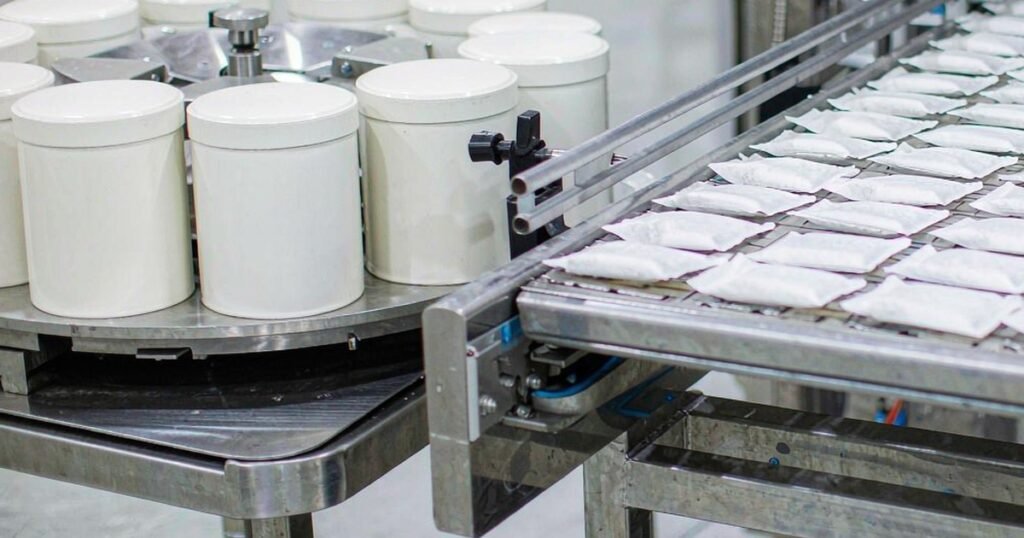
A nicotine pouch packaging machine is a multi-lane form-fill-seal system that doses 0.4–0.75 g of a nicotine-cellulose blend into non-woven pouches at 200–1,200 pouches per minute. As of November 2026, two of the numbers it controls — pouch weight and pouches per can — stopped being purely machine settings. The FDA authorised 24 VELO products on 30 October 2026 by counting packaging configurations separately, and EU finance ministers vote on 9 November 2026 on a minimum excise duty charged per kilogram of pouch material. Also called a pouch filling machine, a pouch making machine or an oral pouch machine, this equipment is now specified around two figures that regulators read as product identity and tax authorities read as money.
What changed in nicotine pouch packaging in the week to 7 November 2026?
Four developments in ten days all land on the same two parameters.
- 30 October 2026 — the FDA authorised 24 VELO products. Modoral Brands, BAT’s US pouch business, received marketing granted orders for eight flavour-format combinations, every one at 4 mg. The agency counted them as 24 products because each combination ships in three packaging configurations, all with certified child-resistant designs. Authorised nicotine pouch products in the US now total 67: ZYN 31, VELO 24, on! and on! PLUS 12.
- Q4 2026 — ZYN moves its 3 mg and 6 mg dry cans from the legacy count to 20 pouches per can. The authorised ZYN line was reviewed at 15 pouches per can. The count is a packaging attribute of an authorised product, not a flavour detail.
- 9 November 2026 — EU finance ministers vote on a minimum pouch excise duty. The Irish presidency’s 26 October compromise sets the final minimum at EUR 50 per kilogram, down from EUR 80, with a 50%-of-retail-price alternative and earlier steps reported at EUR 30/kg from 2028. Sweden, which taxes pouches at roughly EUR 18/kg today, needs only its own vote to block a file that requires unanimity.
- Swedish Match ordered to re-label ZYN ingredients. Sweden’s Public Health Agency wants individual flavouring substances disclosed instead of grouped under the word flavourings, backed by a conditional SEK 2 million per month penalty. Ingredient-level labelling means more label variants per line, not fewer.
The commercial backdrop explains the regulatory attention: current nicotine pouch use among US adult tobacco users rose from 3% in 2021 to 10.2% in 2024, and ever-use from 16.4% to 31.1%.
Why did the FDA count 8 VELO products as 24 authorised products?
Because packaging was inside the review. Where packaging affects stability, shelf life, moisture and child resistance, each configuration is treated as its own product — which is why eight flavour and format combinations became twenty-four orders. For anyone building a pouch production line this has one hard consequence: the can is named in the marketing granted order. A packaging change is not a changeover. It is a new tobacco product under section 910(a)(1) of the FD&C Act.
US buyers will say can, Nordic buyers portion, British and EU buyers tobacco-free nicotine pouch or modern oral. All of them are now buying against a document that names a package, so nicotine pouch packaging machine specifications have to be written in the same language as the application.
Does changing pouches per can or can format require a supplemental PMTA?
Usually yes. A supplemental PMTA under 21 CFR 1114.15 is the route for a modification that creates a new tobacco product but needs only limited new information, because the applicant cross-references the formulation, manufacturing and health-risk sections of the original application. The supplement still has to carry full new-product information, a description of each modification with a comparison to the authorised version, labelling where it differs, postmarket information and a certification statement. Postmarket reporting obligations under 21 CFR 1114.41 continue in either case.
So the question is never whether a pouch-to-can loader can be reset to 20 pouches — it can, in an afternoon. The question is whether that configuration appeared in the order you filed.
Which line changes are machine settings and which are new products?
| Change on the line | What it is mechanically | Regulatory reading |
|---|---|---|
| Fill weight inside the authorised weight and strength | PLC recipe recall, ±0.5–2% dosing tolerance | Reportable change, not a new application |
| Fill weight that moves the mg per pouch outside the authorised strength | New dosing setpoint and QC release limits | New tobacco product — supplemental PMTA |
| 15 → 20 pouches per can | Loader count recipe, checkweigher setpoint, label revision | New packaging configuration |
| Can diameter 40 → 53 mm | Change parts on unscrambler, loader and capper, 2–4 hours | New packaging configuration |
| Mini to Slim pouch, 0.4 g to 0.7 g | Forming window and sealing tooling, 15–20 minutes tool-free | New product if the format is named in the order |
| Ingredient-level flavour declaration | Label artwork, vision inspection recipe | Labelling change inside the authorisation |
| Replacing an ageing machine with one of identical capability | Same speeds, same tolerances, same sealing method | Equipment change only — no new product |
That last row is the one buyers get wrong in both directions. Replacing worn equipment with a machine of the same capability does not create a new tobacco product, provided the process parameters in the filed application are still met. Changing the pouch count on the same machine does.
What does a per-kilogram excise duty change on the filling line?
It turns grammes into a recurring line item. A duty set per kilogram charges you for the material you actually put in the pouch, not the material the label promises, so every gramme of overfill is taxed at the same rate as sellable product. Independent estimates put the added duty at roughly EUR 0.43–0.45 per can in countries with no pouch excise today, such as Germany, Ireland, Slovenia and Croatia, with the exact figure depending on can weight.
The mechanics matter more than the headline. To keep a 0.70 g pouch above the declared net weight, a ±2% auger line has to run its mean fill at about 0.714 g. The 2% is not sloppiness — it is the tolerance you paid for. It is also 2% of your excise, every shift, forever, on top of the nicotine blend you gave away.
How much does a 2% overfill cost under a per-kilogram duty?
Work it out on a realistic line: six lanes at 600 ppm, one 7.5-hour shift, 20 pouches per can. That is 270,000 pouches and 189 kg of product per shift.
| Duty rate (EU step) | Duty per shift | Cost of 2% overfill per shift | Cost of 2% overfill per year |
|---|---|---|---|
| EUR 30/kg (from 2028) | EUR 5,670 | EUR 113 | EUR 28,350 |
| EUR 50/kg (from 2030) | EUR 9,450 | EUR 189 | EUR 47,250 |
| EUR 80/kg (from 2032) | EUR 15,120 | EUR 302 | EUR 75,600 |
At 250 shifts a year, moving from a ±2% auger filler to a ±0.5% multi-head weigher recovers about 1.5 points of that overfill: EUR 56,700 a year at the EUR 80/kg step on the same line, before counting the blend itself. That arithmetic — not the duty headline — is what should decide whether a micro-auger or a multi-head weigher goes into the quotation.
A per-kilogram duty is not the same as a per-pouch duty: a 20-count can of 0.4 g Mini pouches carries roughly half the excise of a 20-count can of 1.0 g Large pouches at the same rate per kilogram. Any cost comparison that ignores pouch weight is wrong by a factor of two.
What should be written into the RFQ before these rules land?
- Name the exact packaging configuration you intend to file: can diameter and height, pouches per can, closure type. Ask the supplier to confirm which configurations the change parts cover without a new loader.
- State the dosing method and its tolerance in grammes per pouch, not just as a percentage, so the excise exposure can be calculated.
- Ask for weight-control capability: checkweigher feedback to the filler, per-pouch rejection logging, and batch records that survive an FDA records request.
- Confirm the sealing method against your non-woven. Ultrasonic sealing is not the right choice for heat-sealable laminate films — heat sealing gives higher throughput there. It matters here because a seal that lets moisture through invalidates the stability data inside the authorisation.
- Count your SKUs honestly. Tool-free changeover is not worth specifying if you run one configuration; with three or more authorised packaging configurations it is the difference between a Saturday morning and a lost week.
- Ask what is on the HMI. Recipe storage should hold pouch weight, count per can and sealing setpoints as one named product, matching the supplement you filed.
- Ask for the equipment change path — the letter that confirms a replacement machine of identical capability does not alter the filed process parameters.
What is the next step?
If you are weighing up a line for a configuration you have not filed yet, the decision order is fixed: settle the package, then the dosing method, then the lanes. For buyers without a PMTA of their own, the faster path is OEM pouch manufacturing under a facility that already runs authorised configurations. To size a six-lane line around a specific can weight and count, contact our engineering team with the package dimensions and target ppm, or read more about PouchMfg and how we document changeovers for regulated buyers.