PM300 Pre-made Bag Packaging Machine
Wider premade-pouch filler, up to 300 mm bag width
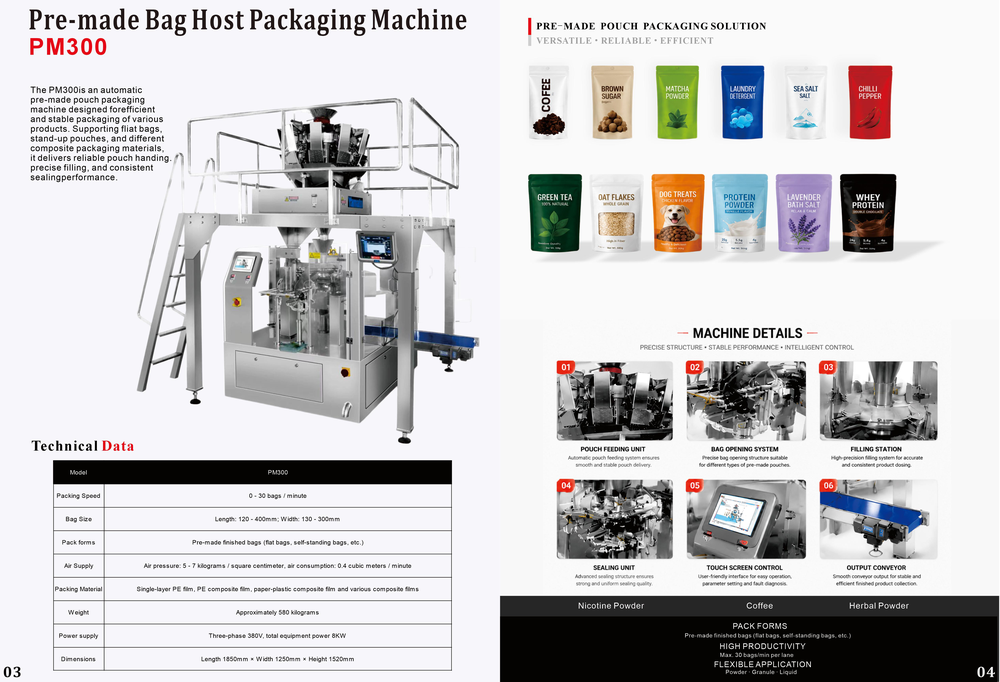
The PM300 is an automatic pre-made pouch machine for efficient, stable packaging of various products. Supporting flat bags, stand-up pouches and different composite films, it delivers reliable pouch handling, precise filling and consistent sealing.
Specifications
| Packing speed | 0–30 bags/min |
|---|---|
| Bag size | L 120–400 mm × W 130–300 mm |
| Pack forms | Flat / stand-up / zipper pouches |
| Air supply | 5–7 kg/cm², 0.4 m³/min |
| Power | 3-phase 380V, 8 KW |
| Weight | ≈ 580 kg |
Applications
Why the PM300 Pre-made Bag Packaging Machine fits your production
The PM300 Pre-made Bag Packaging Machine takes ready-made bags — stand-up pouches, flat pouches, zip bags — opens them, fills, and seals. Rated output: 0–30 bags/min. The trade versus form-fill-seal is simple: premade bags cost more per piece, but the shelf presentation is better, the bag shapes available are far wider (stand-up, shaped, reclosable), and print quality is perfect because the film was pre-printed and converted by the bag maker.
This is the right choice when the pouch itself carries the brand — premium food, supplements, oral care, nicotine pouches in retail-ready packs. If your volume is above roughly 60 bags per minute sustained, revisit whether a VFFS line fits better; below that, premade economics usually win.
Key features that matter on the floor
- Output — 0–30 bags/min, with realistic line efficiency planned at 60–70% of rated speed
- Bag size range — L 120–400 mm × W 130–300 mm — covers several SKUs without mechanical changeover
- Power supply — 3-phase 380V, 8 KW
- Applications — Powder, Granules, Liquid, Pet food, Detergent, Protein, Chicken flavor
- Construction — GMP-grade SUS304 product-contact parts, CE certified
- Documentation — Manuals and remote video commissioning in English, Spanish, Portuguese, Vietnamese, Indonesian, Turkish and Arabic
How it works, step by step
- Bag loading — pre-converted bags are stacked in the magazine; the machine picks them one at a time, so bag quality is checked at the factory, not on your line.
- Bag opening — vacuum or grippers open the bag mouth; a failed open triggers a no-fill no-seal error instead of a product spill.
- Filling — product is dosed straight into the opened bag; multi-head fillers keep cycle time short.
- Sealing — the sealing jaw closes the bag, with options for degassing valves, zippers or tear notches already built into the premade bag.
- Discharge — sealed pouches exit for secondary packing.
Because bags arrive ready-made, changeover between SKUs is mostly a magazine and recipe change — minutes, not hours.
Installation, compliance and after-sales
To quote accurately we need four things: your product and portion weight, target output per minute, the bag format you want (or a photo of a competitor's pack), and your plant voltage and compressed-air supply. With those, the quotation includes the line layout, film specification and delivery scope.
Every machine is tested and accepted at our 20,000 m² factory in Zhongshan, Guangdong, before dispatch. We ship with CE documentation, commission by remote video call in your working language, and stock spare parts for fast dispatch — the same parts list is used across our platforms, which keeps maintenance simple. PouchMfg is the oral-pouch machinery brand of PACKMATE (GUANGDONG) Co., Ltd., exporting to 60+ countries.
Common pairings on our lines: the compact PM230. Or see the full range on the products index.
Next step: send us your product weight, target output and bag format, and we will come back with a line layout, film specification and a quotation — usually within two working days. Contact the engineering team.
Frequently asked questions
PM230 vs PM300 — what is the difference?
Same speed (0–30 bags/min) and power; PM300 accepts wider pouches up to 300 mm vs 230 mm on the PM230.
Is touchscreen control included?
Yes — PLC + touchscreen with multi-language support, fault diagnosis and parameter memory.