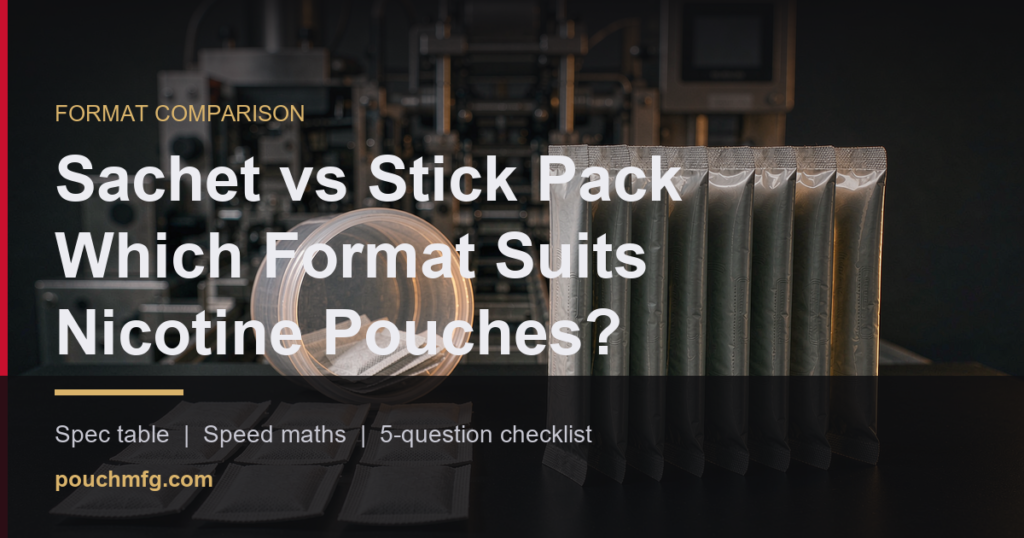
A nicotine pouch is a flat portion sachet, not a stick. If you are building an oral nicotine brand, the format you need is a heat-sealable nonwoven sachet roughly 12-25 mm wide and 28-45 mm long, holding 0.3-1.2 g of blend, sealed on three or four sides and counted into a can. A stick pack is a narrow laminated tube, typically 10-25 mm wide and 50-120 mm long, built for free-flowing powders, granules or liquids in 0.5-20 g doses. Both are made on the same vertical form-fill-seal principle, but they need different film, different dosing tools and different downstream equipment. This guide gives you the spec table, the speed maths, an honest answer on whether one machine can do both, and the one case where buying a stick pack machine first is the smarter move.
What is the difference between a sachet and a stick pack?
A sachet is a short, wide, flat pillow or rectangular pack with a low length-to-width ratio. A stick pack is a long, narrow tube with a high length-to-width ratio. That single geometric difference drives everything downstream: the film path, the forming shoulder, the sealing jaw geometry, the dosing system and the way the finished packs are handled.
Portion sachets for oral nicotine are almost always made from heat-sealable nonwoven filter paper. The material has to be porous enough to let saliva carry flavour and nicotine out of the pouch while the user holds it in the lip, but strong enough to survive a 30-60 minute session without bursting. Stick packs run the opposite way: they are made from high-barrier laminates such as PET/AL/PE or OPP/AL/PE, designed to keep moisture and oxygen out for 12-24 months of shelf life.
A practical way to keep the two straight: a portion sachet is a delivery device the consumer puts in their mouth. A stick pack is a single-dose container the consumer empties into something else.
Why does a nicotine pouch use a flat sachet and not a stick?
Because of dose size and mouth feel. A standard all-white portion holds 0.4-0.8 g of blend at 8-15% moisture; a moist original portion can run to 32.5% moisture. The blend is a damp, cohesive, non-free-flowing mass, not a dry powder. It has to sit flat and soft against the gum, and the pack must not have hard sealed edges that irritate the lip.
A stick pack 10-25 mm wide would hold 0.5 g of nicotine blend as a thin column less than 15 mm long, with a long perimeter seal running down the whole length. That geometry is wrong on three counts: it does not sit comfortably in the lip, it puts a stiff longitudinal fin seal against sensitive tissue, and the extra seal area wastes film on a pack worth a few cents.
So the format question is usually settled before you ever talk to a machine builder. If your SKU is a nicotine pouch, you need a portion sachet line. The interesting question is what happens when your product range also includes powders.
Sachet vs stick pack: side-by-side specification table
| Parameter | Portion sachet (nicotine pouch) | Stick pack |
|---|---|---|
| Typical pack size | 12-25 mm wide x 28-45 mm long (large portions to 70 mm wide) | 10-25 mm wide x 50-120 mm long |
| Fill weight | 0.3-1.2 g standard; 0.5-5.0 g machine range | 0.5-20 g |
| Packaging material | Heat-sealable nonwoven filter paper, 30-60 gsm | PET/AL/PE, OPP/AL/PE, paper/AL/PE laminates |
| Seal type | Three-side or four-side flat seal, 4-5 mm seal width | Fin (lap) or pillow seal with cross-seal top and bottom |
| Dosing system | Servo auger or micro-weigher (cohesive, damp blend) | Servo auger, volumetric cup, or piston pump for liquids |
| Dosing accuracy | ±1-2% in production | ±1-2% depending on flow characteristics |
| Typical lane count | 4-10 lanes | 2-12 lanes |
| Cycles per minute per lane | 30-50 | 20-50 |
| Total line speed | Up to 800 pouches/min | Up to 1,200 packs/min |
| Maximum film roll width | 420 mm | 420 mm (up to 880 mm on wide-frame builds) |
| Downstream equipment | Counting, can filling, capping, labelling | Counting, cartoning, bundle wrapping |
| Product contact material | SS304, 0.6-0.8 MPa clean dry air | SS304, 0.6-0.8 MPa clean dry air |
Which dosing system does each format need?
Dosing is the single most mis-specified part of a pouch buying decision, and it is the part that decides your giveaway cost.
- Servo auger. The default for nicotine blends. A servo-driven screw meters a cohesive, damp, non-free-flowing mass by volume with closed-loop weight feedback. It handles 8-32.5% moisture without bridging.
- Volumetric cup. Suited to free-flowing granules and dry powders with stable bulk density. Cheaper, faster, but accuracy drifts when bulk density changes between batches.
- Micro-weigher. Multi-head or linear weigher feeding each lane. Highest accuracy at low dose, highest capital cost, and it slows the cycle below roughly 30 cycles/min per lane.
- Piston pump. Only for liquid or gel stick packs. Not relevant to portion sachets.
The commercial point: moving average overfill from +3% to +1% on a 4-lane line running 0.5 g portions at 300 pouches/min saves roughly 48 kg of blend per year per shift at a 48 million pouch annual volume. At USD 60/kg for a finished nicotine blend that is about USD 2,900 a year, and at higher-value actives the figure scales directly.
How fast can each format actually run?
Theoretical output is simple arithmetic: active lanes x cycles per minute. Real output is that figure minus changeovers, rejects, film splices and downstream stops. Use the table below as a planning baseline, then derate it by the efficiency you actually hold.
| Lanes | Cycles/min per lane | Theoretical output | 8-hour shift at 85% OEE |
|---|---|---|---|
| 4 | 40 | 160 ppm | ~65,000 packs |
| 6 | 40 | 240 ppm | ~98,000 packs |
| 8 | 40 | 320 ppm | ~130,000 packs |
| 10 | 40 | 400 ppm | ~163,000 packs |
| 12 | 40 | 480 ppm | ~196,000 packs |
Two constraints bite before the speed figure does. First, film width: a 420 mm maximum web means 12 lanes is only possible with packs around 25 mm wide plus seal allowance. Second, downstream capacity: if your can filler or cartoner cannot absorb 400 pouches a minute, the whole line runs at the speed of the slowest unit, not the speed of the sealer.
Can one machine make both sachets and stick packs?
Yes, but treat it as a format changeover, not a recipe change. A genuine swap between portion sachet and stick pack involves at least four physical changes:
- Forming tube and shoulder – the cross-section changes from flat-wide to narrow-deep.
- Sealing jaws – flat three-side or four-side jaws versus fin-seal bar plus cross-seal jaws.
- Dosing unit – auger tool for pouch blend, cup or pump set for stick contents.
- Film path and registration – nonwoven runs at different tension and different seal temperature window than an aluminium laminate.
As a planning figure, budget 3-4 hours for a first changeover with a technician present, dropping to 60-90 minutes once operators have run the sequence a dozen times. If you expect to switch more than twice a week, buy two dedicated machines rather than one convertible one; the capital is recovered quickly in recovered uptime.
There is also a contamination question. Running tobacco or nicotine blend and then a food-grade powder on the same auger and hopper requires a validated cleaning procedure and, in most regulated markets, documented swab results. Many contract packers keep the two product families on physically separate equipment for exactly this reason.
When should you buy a stick pack machine instead?
| Choose a portion sachet line if… | Choose a stick pack line if… |
|---|---|
| Your core SKU is nicotine or caffeine pouches at 0.3-1.2 g | Your core SKU is a free-flowing powder at 1-20 g |
| Finished goods go into cans of 15-25 pouches | Finished goods go into cartons or display boxes |
| Blend moisture is 8-32.5% and cohesive | Product is dry, free-flowing, or liquid |
| You need nonwoven filter paper as the pack material | You need an aluminium barrier laminate for shelf life |
| Regulated nicotine or pharma documentation is required | Food-grade or supplement documentation is sufficient |
The one case where the stick pack machine comes first: you are a brand owner whose volume today is caffeine, electrolyte or supplement sticks, and nicotine pouches are a planned second category within 18 months. In that situation, buy the stick line now, spec the convertible tooling package, and add a dedicated portion sachet line when the pouch SKU actually carries volume. Specifying a convertible machine costs a few thousand dollars up front; discovering after installation that your frame cannot take the second tooling set costs a whole machine.
What does format choice mean for film cost and shelf life?
Portion sachets win on material cost per pack because the pack is small and the material is cheap nonwoven. Stick packs win on barrier because the laminate carries aluminium. For a nicotine pouch the shelf-life problem is moisture retention, not oxygen ingress, which is why the pouch lives inside a sealed can with a humidity-controlled headspace rather than relying on the sachet film alone.
For stick packs holding hygroscopic powder, the laminate does the whole job. Downgrading from PET/AL/PE to a metallised film saves perhaps 10-15% on film cost and can cut shelf life from 24 months to 12. Run the numbers against your actual distribution cycle before you optimise the film spec.
How to choose: a five-question checklist
- What is the dose weight and tolerance? 0.5 g at ±1% needs a servo auger with checkweigher feedback, not a volumetric cup.
- What is the target monthly volume? Work backwards from cans or cartons per month to required pouches per minute, then apply 85% OEE and your real shift pattern.
- What is the blend moisture and flow behaviour? Above roughly 20% moisture, cohesion dominates and a plain cup filler will not hold tolerance.
- What is the downstream? Can filler, cartoner or both – and does it match the line speed?
- Will a second format ever run on this machine? If yes, get the convertible package written into the contract with a documented changeover time, not a verbal promise.
Next step
Bring your portion weight, monthly volume and target pack drawing, and we will size the lane count, select the dosing system and price the downstream to match. If you are still deciding between building your own line and outsourcing, our OEM pouch manufacturing team runs toll production for brands that want to validate a SKU before committing capital.
Talk to an engineer about your format decision on the nicotine pouch packaging machine range, or send specifications through the contact page. You can read more about PouchMfg and how we build sachet and stick pack machinery for oral nicotine and powder producers.