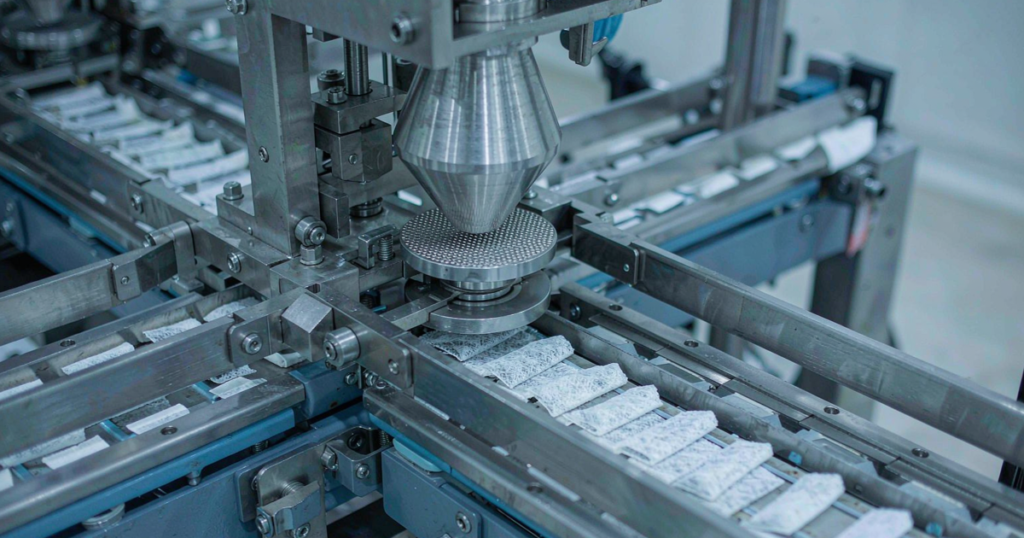
Ultrasonic sealing and heat sealing are the two ways a nicotine pouch machine closes a non-woven pouch. Heat sealing presses heated jaws at 130–160 °C against the web for 0.5–1.0 s. Ultrasonic sealing delivers 20 kHz vibration at 18–35 µm amplitude for 20–150 ms and melts the fibre at the interface while the tool itself stays cool. Also called a pouch filling machine, a pouch making machine or an oral pouch machine, this is the same equipment that forms, doses and seals 0.4–1.0 g portions at 200–1,200 pouches per minute — and the sealing station is where most of that output is either won or lost.
One note on vocabulary before we go further, because it decides whether you find the right machine at all: in the United States buyers search for a nicotine pouch machine or a pouch production line (in the US, snus means tobacco-leaf pouches, not the all-white product). In Sweden and the Nordics the same machine is a snus machine or a portion packing machine. In the UK and EU the compliant term is tobacco-free nicotine pouch (TFNP), modern oral or all-white. You will also see people type “Zyn pouch machine” or “Velo snus” — they mean the same class of equipment.
What is the difference between ultrasonic sealing and heat sealing on a nicotine pouch machine?
Heat sealing pushes energy in from the outside. Cartridge heaters hold a pair of jaws at temperature — a typical station runs four 500 W heaters, so roughly 2 kW of continuous draw just to sit there — and the heat has to travel through the web to reach the interface. Ultrasonic sealing generates the heat inside the material: a generator drives a piezoelectric stack at 20 kHz, a booster and titanium horn step the amplitude up to 18–35 µm, and the vibrating horn presses the web against a patterned anvil at 0.3–0.6 MPa. Interfacial friction takes the polypropylene past its 160–165 °C melting point in 20–150 ms, then it recrystallises the moment the pulse stops.
That single difference — outside-in versus inside-out — drives every other trade-off in this article.
| Parameter | Heat sealing | Ultrasonic sealing |
|---|---|---|
| Energy path | External conduction from heated jaws | Internal friction at the fibre interface |
| Tool temperature | 130–160 °C typical for pouch-grade nonwoven | Tool stays cool; melt is localised |
| Dwell / weld time | 0.5–1.0 s (0.3–2.0 s range) | 20–150 ms |
| Typical seal width | 5–6 mm | 3–4 mm |
| Powder in the seal area | Weak seal or leaker — the classic failure mode | Welds through residue |
| Speed ceiling | Mature; scales to 1,200 ppm on 12 lanes | Cycle time limits the top end; ~40 bags/min slower in like-for-like VFFS trials |
| Energy draw | Continuous, to hold jaw temperature | 50–75% less |
| Capex | Lower | Higher — generator, horn and anvil per station |
| Maintenance | Heater and thermocouple swaps, low cost | Horn and anvil wear, periodic retune; plan sonotrode replacement every 6–12 months |
| Web requirement | Heat-sealable binder fibre or coating | Thermoplastic content (PP/PE) in the web |
How hot should the seal jaws be on pouch-grade nonwoven?
Hotter is not stronger — it is just more damaged. Test data on a 26.5 g/m² oral-pouch web (60% soft pulp, 40% PP/PE) shows exactly where the window closes:
| Jaw temperature | Seal strength at 2 mm | at 3 mm | at 5 mm | Surface change |
|---|---|---|---|---|
| 120 °C | 0.04 N/mm | 0.18 N/mm | 0.26 N/mm | None |
| 150 °C | 0.27 N/mm | 0.22 N/mm | 0.26 N/mm | None |
| 180 °C | 0.34 N/mm | 0.26 N/mm | 0.26 N/mm | Hardening, discolouration |
| 210 °C | 0.39 N/mm | 0.33 N/mm | 0.35 N/mm | Hardening, discolouration |
Read that table from a brand owner’s seat, not a lab seat. At a 2 mm seal width, 120 °C gives you almost no strength (0.04 N/mm) and 150 °C gives you a usable seal. Push to 180 °C and you buy another 0.07 N/mm — and you pay for it with surface hardening and discolouration. On an all-white pouch, a yellowed or glazed seam is a visible defect that a consumer sees before they ever feel the seal. The practical answer for a 2–3 mm seal is 150 °C, not “as hot as possible”.
What are the real ultrasonic settings — frequency, amplitude, force and time?
Write these four into your RFQ, because a supplier who will not commit to numbers on paper will not hit them on your floor:
- Frequency: 20 kHz is the standard for pouch seams; 30–35 kHz is used where you want finer control and less heat input on light webs.
- Amplitude: 18–35 µm peak-to-peak at the horn face. Too much amplitude on a 25–35 gsm web burns through; too little gives a partial weld that passes a visual check and fails a burst test.
- Weld force: 250–1,100 N depending on seam length, delivered at roughly 0.3–0.6 MPa at the interface.
- Weld time: 20–150 ms. This is the number that caps your ppm, and it is why ultrasonic stations lose the pure speed race.
Ask for automatic frequency tracking with a tight lock window. Horns heat up during a long run, resonance drifts, and without tracking your 20:00 shift produces different seals than your 08:00 shift.
Does ultrasonic sealing really seal through nicotine powder in the seam?
Yes, within limits — and this is the single strongest reason to pay for it. Dry pouch blends in the 0.4–0.5 g mini range are dusty; fines migrate up the web into the cross-seal area, and a heat jaw trying to melt through a layer of powder produces a channel instead of a bond. Ultrasonic energy vibrates the contaminant aside and welds the fibres behind it. That is why the technology moved from snack powders into oral pouch lines in the first place.
The limit is real too. Heavy smear, a wet blend at 50% moisture, or foam in the seal zone still produces micro-channels. Ultrasonic buys you tolerance, not immunity.
Which one is faster?
Heat sealing, and buyers should stop expecting otherwise. In like-for-like form-fill-seal comparisons the heat station runs about 40 bags/min faster, because a 20–150 ms weld plus horn approach and retract is simply a longer cycle than a jaw that is already hot. If your business case depends on 1,200 ppm across 12 lanes, ultrasonic is not the tool for that line.
Does the narrower ultrasonic seal actually save money?
Less than the brochure implies. Take an honest example: a 6-lane line at 800 ppm, one 8-hour shift, 30 mm pouch pitch, web width 0.2 m, 30 gsm nonwoven at roughly USD 30/kg.
- Pouches per shift: 800 × 60 × 8 = 384,000
- Web consumed: 384,000 ÷ 6 × 0.030 m = 1,920 m per day, or about 384 m²
- Weight: 384 m² × 0.030 kg/m² ≈ 11.5 kg per day ≈ USD 346 per day
- Cutting 2 mm off each of two cross seals removes about 4 mm from a 30 mm pitch — roughly 13% of the web
- Saving: about USD 45 per shift-day, or roughly USD 11,000 over 250 working days
Eleven thousand dollars a year does not repay a five-figure ultrasonic premium on its own. Buy ultrasonic for seal integrity on dusty blends and for scorch-free white pouches — not for the web saving.
When is ultrasonic sealing the wrong choice?
Ultrasonic sealing is not the right choice for a heat-sealable coated laminate running at maximum throughput — a well-controlled heat station is faster and cheaper there, and the coating is engineered for conduction heat. It is also the wrong choice if your maintenance team cannot hold a horn and anvil wear schedule; a drifting sonotrode makes inconsistent seals quietly, and you find out at the checkweigher or in a customer complaint, not at the machine.
When is heat sealing the wrong choice?
Heat sealing is not the right choice when your blend dusts into the seal area, or when the web discolours below the temperature you need for strength. If your peel test only reaches spec at 180 °C and the pouch yellows at 180 °C, no amount of PID tuning fixes that — you are fighting the material, and ultrasonic removes the hot jaw from the equation.
Cold seal is worth mentioning and then dismissing: the cohesive coating is not hermetic, the film runs 20–40% more expensive, and oral pouches need a sealed, moisture-managed pack with a 12–18 month shelf life. It does not apply here.
How should you validate the seal before you sign the FAT?
- Send your actual web and your actual blend to the factory trial. A trial on the supplier’s house material proves nothing about your line.
- Run at production speed for 30 minutes, not 5 minutes at 30% speed. Seal defects are time- and temperature-dependent.
- Peel test across the window — 120, 150 and 180 °C — with 10 samples per point, and record N/mm, not pass/fail.
- Add a burst or pressure-decay test plus dye penetration. Peel strength alone will not catch a micro-channel.
- Record the winning recipe in the HMI: temperature, pressure, dwell, or amplitude, force and weld time. Recipe storage is what makes the second shift match the first.
- Get horn and anvil life, spare cost and replacement interval in writing, in the quote — not in an email after commissioning.
- Ask for the measured reject rate on a dusty blend, and make sure the dust extraction and metal detector sit upstream of the sealing station.
- Confirm documentation: CE, ISO 9001, GMP-relevant design, material certificates for contact parts, and the traceability records your FDA PMTA or EU dossier will need.
Which one should you buy?
| Your situation | Pick | Why |
|---|---|---|
| Startup brand, 4 lanes, 200–300 ppm, one format | Heat sealing with PID control | Lower capex, cheap spares, widest material choice |
| Contract packer, 6–8 lanes, frequent flavour changeover | Heat sealing plus dust extraction | Recipe storage and changeover time matter more than weld speed |
| Dry high-dose blend in the 0.4–0.5 g mini range | Ultrasonic sealing | Welds through powder in the cross-seal |
| Premium all-white web where glazing or yellowing shows | Ultrasonic sealing | No hot jaw contact, no discolouration at equal strength |
| 12 lanes chasing 1,200 ppm | Heat sealing, or a hybrid station | Ultrasonic cycle time becomes the bottleneck |
Can one machine do both?
Hybrid stations exist — a heat-seal jaw set plus a swappable ultrasonic module — and they make sense for contract packers running both coated laminate and uncoated nonwoven across the week. Budget for the changeover time and for two spare-part inventories, and make sure the frame and the film path were designed for both, not retrofitted. The same question comes up on sachet and stick pack machinery, where a single station is often asked to run three different film structures.
Does the sealing choice affect compliance?
Indirectly, but significantly. A leaking seam is a dosing problem in disguise: if pouches lose moisture or fines, your mg per pouch drifts away from the value on the label, and in the EU several member states cap nicotine in mg per pouch (Denmark 9 mg, Czechia 12 mg, Italy 16.6 mg, Hungary 17 mg) while others cap it in mg per gram (Finland 16.6 mg/g, Latvia 4 mg/g, Poland 20 mg/g). In the US, products sold as tobacco-free nicotine pouches still sit under FDA oversight and PMTA. Seal integrity is what keeps the label true for the whole shelf life.
What to do next
Bring your web, your blend and your target ppm to the trial, and ask for the numbers in this article to be measured in front of you rather than quoted. If you are specifying a new nicotine pouch packaging machine, our engineering team can run that trial on your material and return the peel, burst and reject data before you commit. If you would rather not buy equipment yet, OEM pouch manufacturing is the faster route to market while you validate demand. To scope a trial, contact our engineering team with your web specification, portion weight and target output, or read more about PouchMfg and how we build multi-lane pouch lines.