News
Industry news, market insights and product updates on nicotine pouch, sachet and stick packaging machinery.

Compact 4-Lane Pouch Machine for Startup Brands: A 90-Day Roadmap to the First Shipped Can
A compact 4-lane pouch machine is the smallest machine class that can carry a commercial nicotine pouch launch on its own: four filling lanes, a footprint of roughly 2,200 × 1,200 mm, about 600 kg of machine weight, 5.5 kW installed power, and an output of 120-180 pouches per minute at 30-45 cycles per minute […]
Read article →
Nicotine Pouch Materials FAQ: Nonwoven GSM, Seal Width, Temperature and Moisture
A nicotine pouch is closed by sealing, not by adhesive, and almost every pouch on the market is made from a food-grade nonwoven of 25–45 g/m² (35–37 g/m² bico-spunbond PE/PET is the industry default), sealed at a width of 2–5 mm with a jaw temperature of 110–160 °C. Those three numbers decide whether the pouch […]
Read article →
Nicotine Pouch Dosing Accuracy: Why ±1% Fill Weight Decides Your Compliance Margin
Dosing accuracy in nicotine pouch filling is the gap between the fill weight of each pouch and the target, expressed as a percentage. At a 0.5 g target, ±1% means every pouch lands between 0.495 g and 0.505 g. Production multi-lane machines hold ±1-2% with a servo-driven auger and ±0.5% or better once weigh feedback […]
Read article →
Multi-Strength Pouch Lines: What 1.5 mg, 11 mg and 20-Count Cans Mean for Packaging Equipment
On September 15, 2026, PMI U.S. confirmed three ZYN portfolio changes that will reach packaging floors before they reach retail shelves: new 1.5 mg and 8 mg dry-pouch strengths, a move from 15 to 20 pouches per can on core 3 mg and 6 mg variants during Q4, and the moist-format ZYN ULTRA line that […]
Read article →
Nicotine Pouch Machine Changeover: How Long It Takes and the 7-Step SOP
A changeover that only swaps the film takes 8–12 minutes on a modern servo-driven multi-lane nicotine pouch machine. A full change — new pouch format, new fill weight, new flavor, plus cleaning and line clearance — takes 22–45 minutes. On a legacy pneumatic machine the same job runs 45–90 minutes. If you run three or […]
Read article →
Nicotine Pouch Machine Lead Time and Installation: 9 Questions Buyers Ask Before Signing
A nicotine pouch packaging machine takes 30-45 working days to build in a standard configuration and 60-90 days as a custom turnkey line. Add 3-6 weeks of sea freight, then 2-5 days of on-site installation and 1-7 days of commissioning before the line holds its quoted speed. The realistic door-to-first-saleable-pouch timeline is 10-16 weeks from […]
Read article →
GMP-Compliant Nicotine Pouch Packing Machine: 10 Requirements Auditors Actually Check
A GMP-compliant nicotine pouch packing machine is one whose product-contact materials, cleanable geometry, dosing control and documentation package can survive a third-party audit. In specification terms that means SS316L or SS304 contact parts with a measured surface finish of Ra 0.8 micrometres or better, no dead legs or threaded product connections, a recipe-driven PLC with […]
Read article →
Sachet vs Stick Pack: Which Format Suits Nicotine Pouches?
A nicotine pouch is a flat portion sachet, not a stick. If you are building an oral nicotine brand, the format you need is a heat-sealable nonwoven sachet roughly 12-25 mm wide and 28-45 mm long, holding 0.3-1.2 g of blend, sealed on three or four sides and counted into a can. A stick pack […]
Read article →
Private Label Oral Pouch Manufacturing: The 8-Stage Process From Sample to Shipped Can
Private label oral pouch manufacturing is the process of having an outside producer make nicotine or functional pouches to your specification and put your brand on the can – you own the formula, the artwork, and the customer; the partner owns the blend room, the pouch line, and the batch records. A typical first run […]
Read article →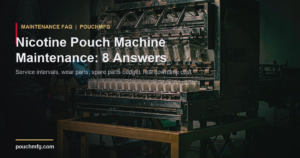
Nicotine Pouch Packaging Machine Maintenance: 8 Questions Answered
A nicotine pouch packaging machine needs about 15 minutes of cleaning per shift, a two-hour weekly check and a half-day quarterly service. Here are the service intervals, wear parts and spare parts budgets buyers ask about most.
Read article →